TRAVEL GUIDES · CURIOSITIES & HIDDEN HISTORY · 2026
From a rooftop racetrack to a revenge skyscraper and ghost subway stations, fifteen Buenos Aires details that go well beyond the guidebooks.
Buenos Aires rewards the curious. Not just with great food and late nights and architecture that stops you mid-sentence, but with the kind of specific, layered, almost novelistic details that turn a city visit into something closer to a long conversation with a well-read stranger.
These are the facts most guidebooks skip, the ones a porteño might mention over a third glass of Malbec at midnight, as if everyone already knew. At Buenos Aires Transfers we spend our days driving visitors through this city, and it never stops handing us stories like these.
Here are fifteen of them. Most people never hear a single one.
01 · THE TREES THAT BLOOM ON SCHEDULE
JACARANDÁ / EL ARBOLADO PORTEÑO
The purple canopy was planned, species by species.
The jacarandás that paint Buenos Aires purple every November are not native to the Río de la Plata. Neither are the palos borrachos or the tipas. Landscape architect Carlos Thays brought them down from the forests of Salta and Tucumán in the late 19th century and planted each species according to its flowering month, so the city would always have color. Buenos Aires blooms exactly when Thays decided it should. He wrote a script with a century-long run time.
→ JARDÍN BOTÁNICO CARLOS THAYS, PALERMO
02 · MORE PSYCHOANALYSTS THAN ANYWHERE ON EARTH
VILLA FREUD / BARRIO NORTE
Therapy here is not a quirk. It is a civic institution.
Buenos Aires has more psychoanalysts per capita than any other city in the world. More than New York. More than Vienna, which should feel at least slightly embarrassed about this. Therapy is discussed at dinner, recommended to acquaintances, referenced in casual conversation. There is even a corner of Palermo nicknamed Villa Freud for the density of consulting rooms around it. The porteño relationship with self-examination is not a cultural accident.
→ PLAZA GÜEMES ("VILLA FREUD"), PALERMO
03 · THE TUNNELS UNDER SAN TELMO
SAN TELMO / EL SUBSUELO
The oldest neighborhood keeps its best chapters below street level.
Under the cobblestones runs a network of 18th-century tunnels, originally built to channel a stream nobody could tame: the Zanjón de Granados. The passages later became smuggling routes, then escape corridors for wealthy porteños fleeing the yellow fever epidemics. San Telmo wears its history on the surface, but the more interesting stories are underground. The Zanjón museum runs guided tours through parts of the original network.
→ DEFENSA 755, SAN TELMO
04 · THE ART MUSEUM THAT USED TO PUMP WATER
RECOLETA / BELLAS ARTES
A Monet, a Manet, and the best Rodin collection outside France, inside a converted waterworks.
The Museo Nacional de Bellas Artes on Avenida del Libertador holds all three. It also holds a secret in plain sight: the building was never meant to show art. It opened in 1870 as the Casa de Bombas de Recoleta, the station that filtered river water and pushed it across the growing city. In 1933 the architect Alejandro Bustillo gutted the machinery and turned the waterworks into a museum. The masterpieces now hang where the pumps once ran.
→ AV. DEL LIBERTADOR 1473, RECOLETA
05 · THE GHOST STATIONS OF THE OLDEST SUBWAY
SUBTE LÍNEA A / 1913
Look out the window between Pasco and Alberti.
Línea A is the oldest subway in South America, opened in 1913. On the stretch between Pasco and Alberti, if you look out at the right moment, you will see two platforms in total darkness where the train never stops. They are the ghost stations, Pasco Sur and Alberti Norte, closed in the 1950s because they sat too close to their active neighbors. The train would brake and accelerate in almost the same motion. There are stories of workers trapped during the excavation. Buenos Aires, as always, prefers the version with ghosts.
→ SUBTE LÍNEA A, ENTRE CONGRESO Y ONCE
06 · THE PALACE THAT HIDES A WATER TANK
BALVANERA / AGUAS CORRIENTES
Three hundred thousand English tiles, built to disguise the plumbing.
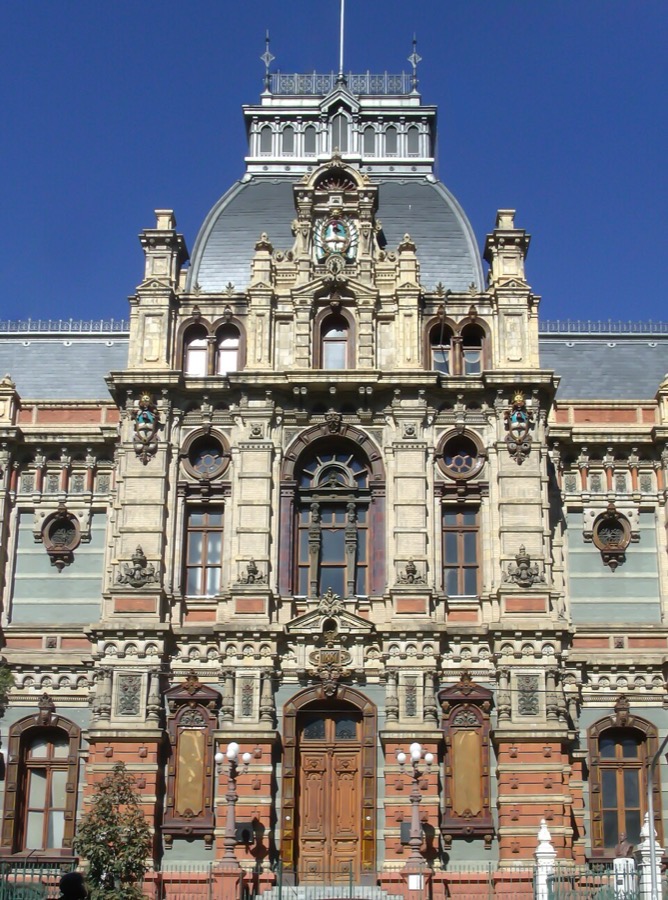
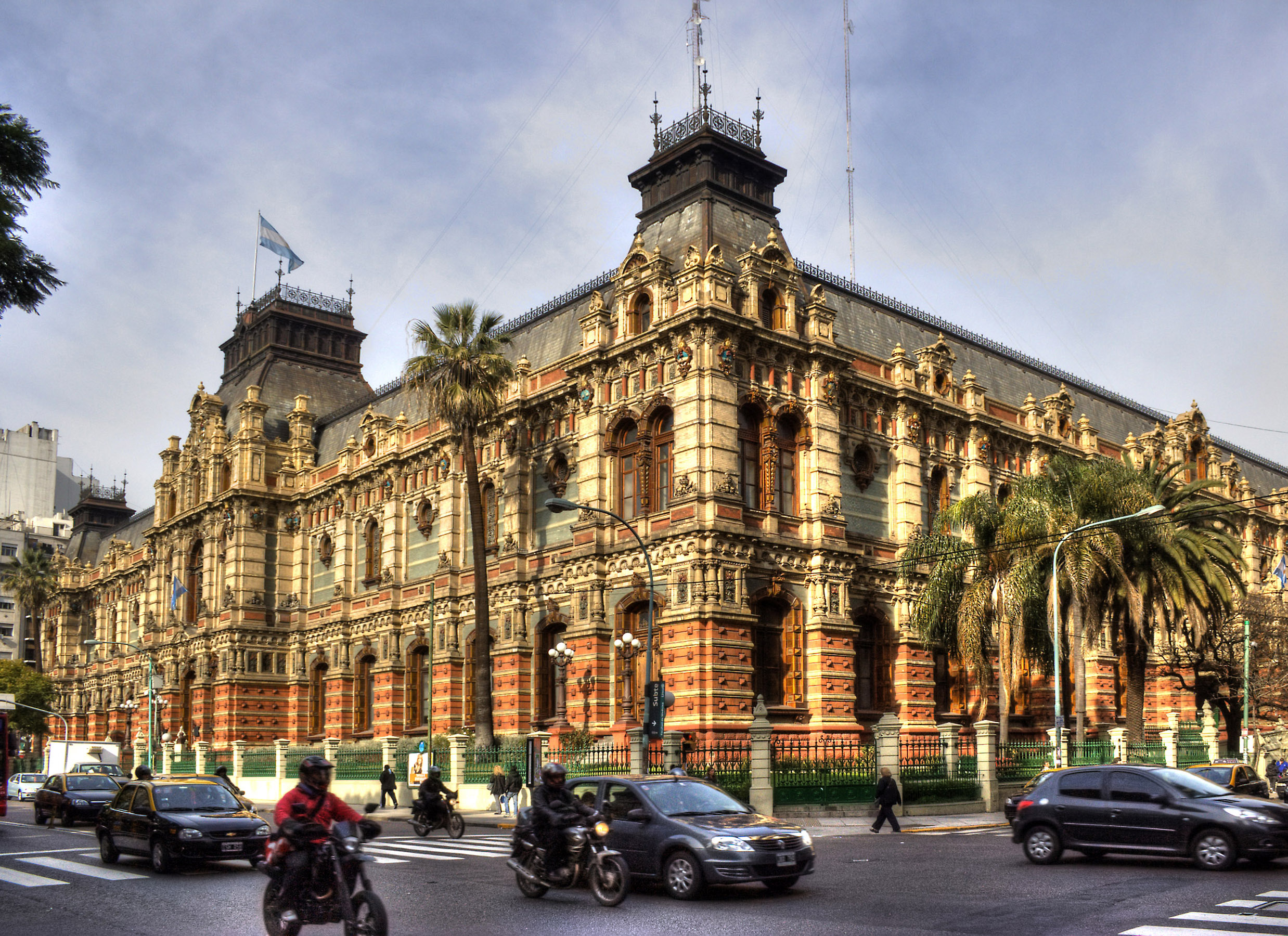
The Palacio de Aguas Corrientes looks like a European royal residence. It wears more than 300,000 glazed terracotta tiles imported from Britain, an ornate ceramic facade, and the bearing of a government ministry. It was built to hide a water pumping plant and its enormous tanks. Late 19th-century Buenos Aires decided infrastructure should be beautiful, or at least dressed well enough that nobody would think about what was happening inside. Most people walk past on Avenida Córdoba without looking up.
→ AV. CÓRDOBA 1750, BALVANERA
07 · DANTE'S COMEDY IN CONCRETE
MONSERRAT / PALACIO BAROLO
A skyscraper built as a map of the afterlife.
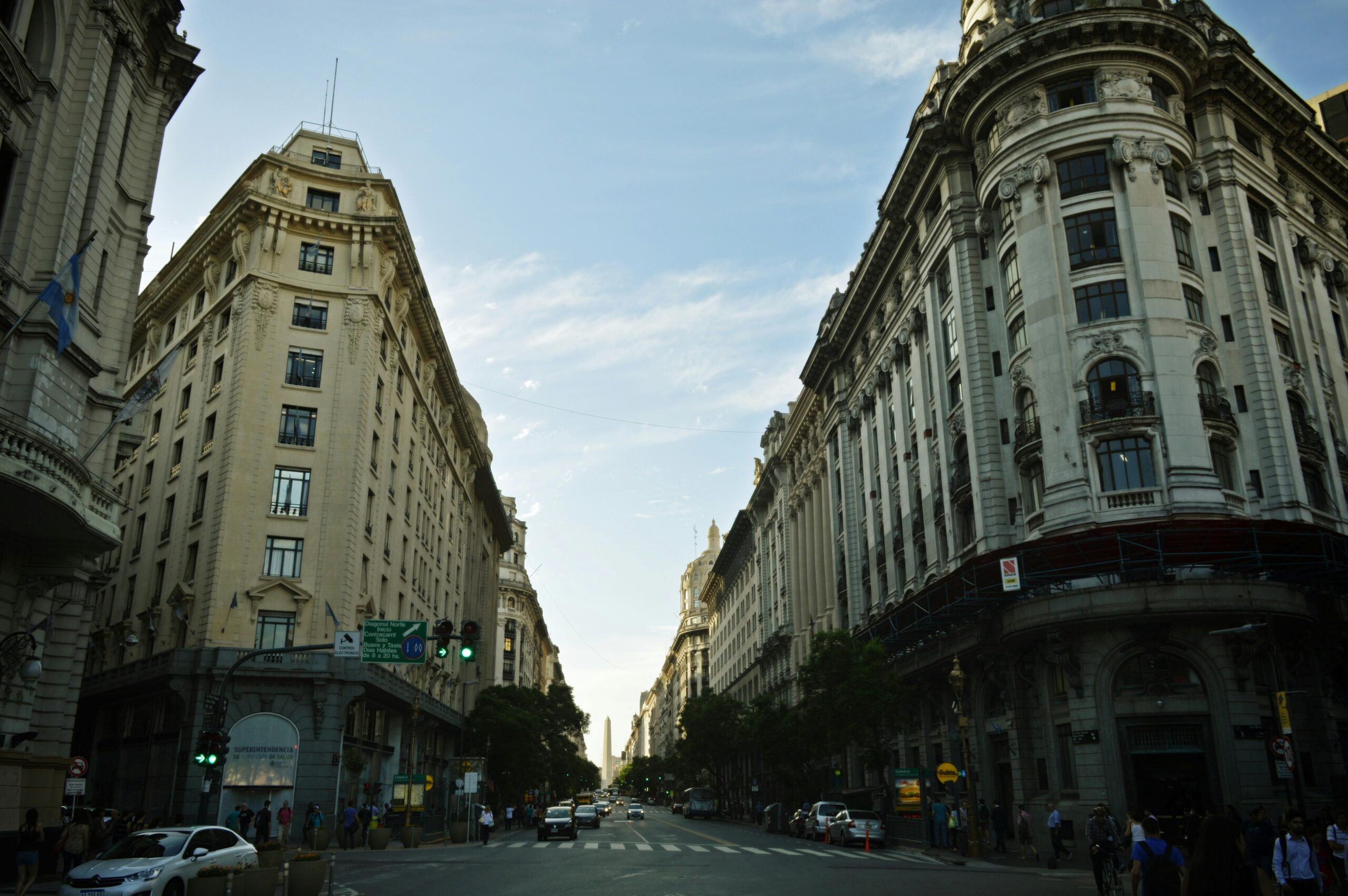
The Palacio Barolo on Avenida de Mayo was designed as a physical representation of the Divine Comedy. The ground floor is Hell, the middle floors Purgatory, the upper section Paradise, and the building stands 100 meters tall, one for each canto of the poem. The detail most visitors miss: architect Mario Palanti built an almost twin tower in Montevideo, the Palacio Salvo. The two were meant to face each other across the Río de la Plata, their lighthouses joined by a beam of light. The bridge of light was never quite completed, but it was always in the plan.
→ AV. DE MAYO 1370, MONSERRAT
08 · THE BUILDING THAT BLOCKED A VIEW
RETIRO / EDIFICIO KAVANAGH
Possibly the most elegant act of revenge in the city's skyline.
In the 1930s, Corina Kavanagh built the tallest concrete skyscraper of its era on a lot facing Plaza San Martín. It blocked the Anchorena family's sightline to the Basílica del Santísimo Sacramento, the church they had built as their family mausoleum. The geometry is verifiable: the only spot from which you can still see the church entrance is a narrow passage named after her. Whether it was calculated revenge or a coincidence of real estate, every guide in the city tells the same version. Buenos Aires likes its architecture with a motive.
→ PLAZA SAN MARTÍN, RETIRO
Some of these you can walk past for years without noticing. A good city tour is really just someone pointing at the right facade at the right moment.
Explore our private Buenos Aires city tours →
09 · THE ROOFTOP RACETRACK IN PALERMO
PALERMO / PALACIO ALCORTA
They tested cars on the roof.
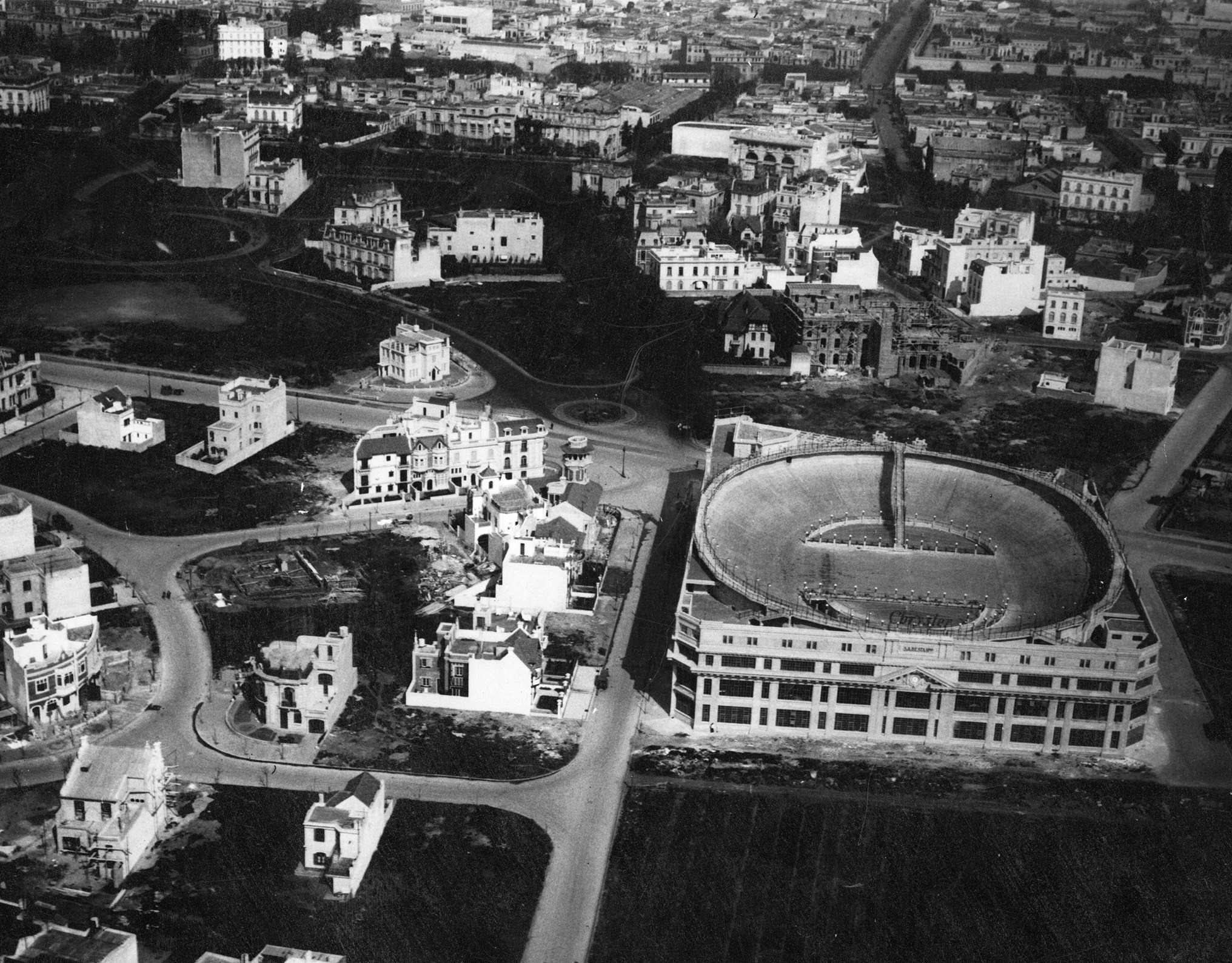
The building now known as Palacio Alcorta is a complex of luxury lofts today. It opened in 1928 as a Chrysler dealership, designed by Mario Palanti, the same architect behind the Barolo. Testing repaired cars in city traffic was impractical, so the solution was a circular asphalt circuit on the roof, banked curves and all. They called it the Estadio Olimpo, and promoted the building as the Primer Palacio Autódromo de Sudamérica.
→ FIGUEROA ALCORTA 3351, PALERMO
10 · THE PENTHOUSE BUILT FOR A NAP
MICROCENTRO / CHALET DÍAZ
A Norman cottage on top of a nine-story building, just for the siesta.
On the roof of a nine-story building at Sarmiento 1113, there is a two-story Norman-style chalet, declared Cultural Heritage of the City in 2014. A Spanish furniture merchant named Rafael Díaz had it built in 1927 for one purpose: to eat lunch and nap without traveling home to Banfield. He also installed a radio station up there, LOK Radio Mueblería Díaz, which eventually became Radio Rivadavia. It remains the most reasonable solution to a commute ever executed nine floors above the street.
→ SARMIENTO 1113, MICROCENTRO
11 · THE WIDEST AVENUE, AND THE PEOPLE WHO RUN IT
MICROCENTRO / AV. 9 DE JULIO
Crossing it before the light changes is a minor sport.
Avenida 9 de Julio is around 140 meters wide. Crossing it in a single attempt before the light changes is considered a small athletic achievement among porteños. There is no medal. Only the quiet satisfaction of having made it, and the mild awareness of being the person stranded on the median while everyone else keeps walking.
→ AV. 9 DE JULIO, MICROCENTRO
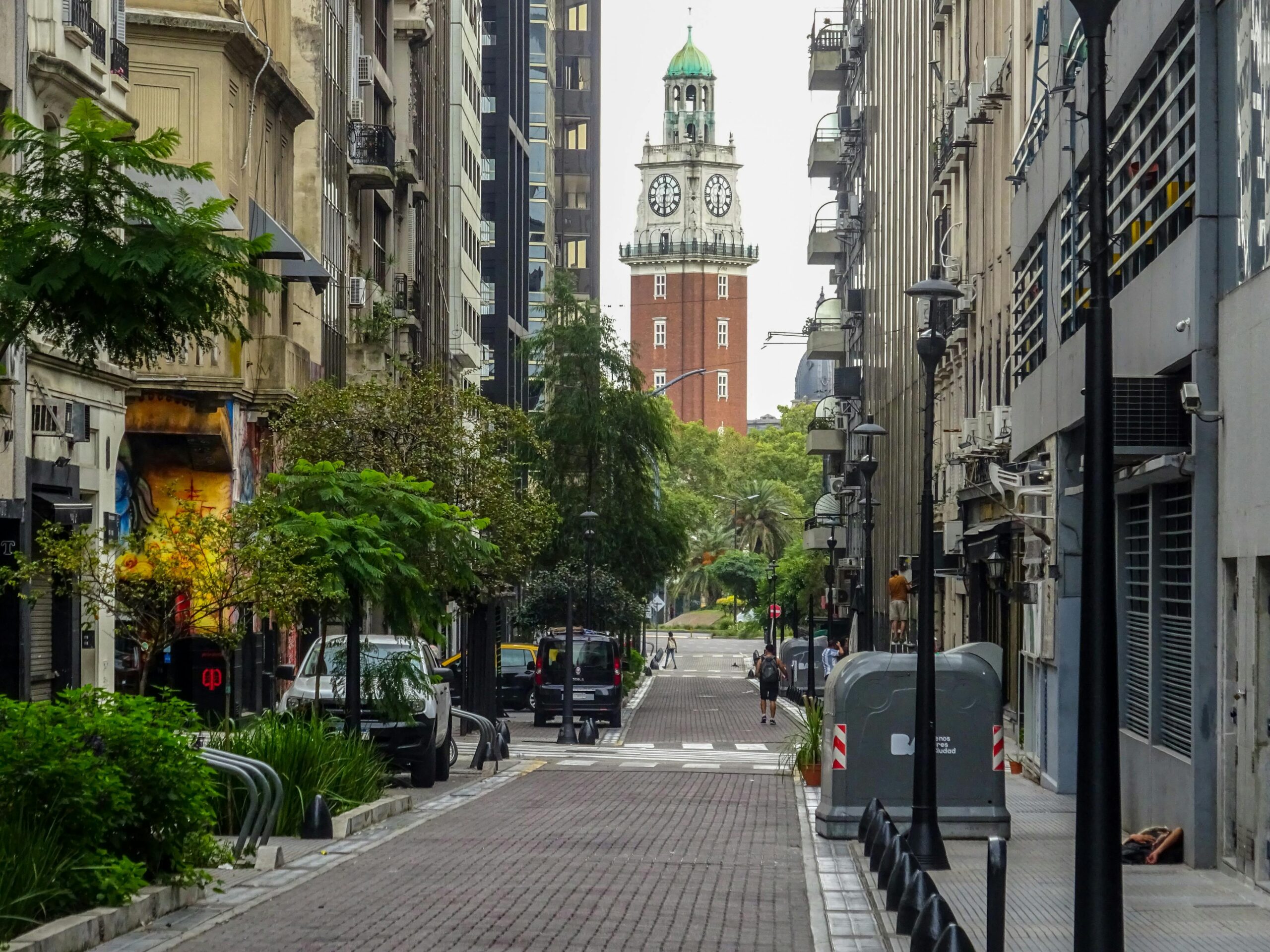
12 · THE CLOCK TOWER THAT LOST ITS NAME TO A WAR
RETIRO / TORRE MONUMENTAL
Its bells still chime like Big Ben. Its name no longer belongs to the British.
The clock tower in Retiro was a gift from the city's British community for the centenary of the May Revolution in 1910. Its bells still chime the Westminster melody, the same sequence London hears from Big Ben. For decades it was simply the Torre de los Ingleses, on a square called Plaza Británica. Then came the Falklands War in 1982, and the map quietly rearranged itself. The square became Plaza Fuerza Aérea Argentina. The tower became Torre Monumental. The bells kept their British melody; the name beneath them did not.
→ PLAZA FUERZA AÉREA ARGENTINA, RETIRO
13 · THE CEMETERY WITH A WAITING LIST
RECOLETA / EL CEMENTERIO
Even permanence here requires an application.
The Recoleta Cemetery has a waiting list. Families apply years in advance for a plot among the neoclassical mausoleums, and pay ongoing fees to maintain their vaults. When they stop paying, the mausoleum slowly deteriorates and sometimes disappears into the general quiet of the place. In Recoleta, even permanence requires attention.
→ JUNÍN 1760, RECOLETA
14 · THE FIRST ANIMATED FEATURE IN HISTORY WAS MADE HERE
CINE ARGENTINO / 1917
Twenty years before Snow White, and now lost forever.
Years before Walt Disney released Snow White, an Italian-Argentine animator named Quirino Cristiani made the world's first animated feature film in Buenos Aires. El Apóstol premiered in 1917, a political satire of President Hipólito Yrigoyen, built from 58,000 frames cut by hand from cardboard and photographed one at a time. It ran about an hour. Nobody can watch it today: the only copy was destroyed when a fire swept through the studio in 1926. The first feature-length animated film in history now survives only in the descriptions of the people who saw it.
15 · THE CITY THAT CHOOSES ITS MYTHS
SAN TELMO / CASA MÍNIMA
The narrowest house in Buenos Aires, and the better story.
In Pasaje San Lorenzo there is a house 2.5 meters wide and 13 meters deep. The story you will always be told is that it belonged to a freed slave, handed the small lot by his former owner when he was granted his freedom. The historical reality is more mundane: a leftover sliver from a 19th-century subdivision. Buenos Aires knows this. It chose the better version anyway. A city that has spent two centuries deciding which stories to keep, and keeping them well.
→ PASAJE SAN LORENZO 380, SAN TELMO
Frequently Asked Questions
What is the most unusual thing to see in Buenos Aires?
A few favorites that rarely make the guidebooks: the rooftop where a 1920s dealership tested cars (Palacio Alcorta), the Casa Mínima in San Telmo at just 2.5 meters wide, and the Palacio Barolo, a skyscraper laid out like Dante's Divine Comedy. All three fold easily into a half-day private city tour.
Can you visit the Palacio Barolo?
Yes. The Palacio Barolo on Avenida de Mayo runs guided visits, including access up toward its lighthouse, with some of the best views over the historic center. It is one of the most rewarding stops on any architectural tour of the city.
Where is the narrowest house in Buenos Aires?
La Casa Mínima sits on Pasaje San Lorenzo in San Telmo and measures about 2.5 meters across. It is one of the quiet highlights of a walking tour through the neighborhood's colonial core.
See the City Behind the Facts
Buenos Aires rewards the people who look a little closer. A private tour with a driver who knows these stories turns a list of curiosities into an afternoon you will remember for years, told at your own pace, with time to stop wherever a facade makes you look twice.