GETTING AROUND BUENOS AIRES · SAFETY · 2026
The real question is not whether the app works. It is what happens in the ten minutes between booking a car and getting into one, and that answer changes depending on where you are standing.

We are a private transfer company, so you can reasonably expect us to tell you that ride apps are dangerous and you should book a car with a driver instead. That is not what this article says.
Ride apps in Buenos Aires are used by an enormous number of people every day, including plenty of visitors, and most rides are unremarkable. Is Uber safe in Buenos Aires? For getting across the city on a normal afternoon, it is a normal tool with normal risks.
What is worth understanding is where the friction actually is, because it is not where travellers expect. The problems are concentrated in three specific situations, and two of them can ruin an arrival day.
The short version
- Inside the city, on a normal trip: it generally works, and the usual precautions you would take anywhere apply.
- At the airport: this is the difficult one, and it is worth reading the section below before you land.
- Late at night, in an unfamiliar area, with luggage, or without a working local phone: this is where the app stops being the convenient option.
The airport is the real problem, and it is not about crime
The situation that catches travellers out at Ezeiza is not a dangerous driver. It is a pickup that does not happen.
There are designated, signposted pickup points for app cars at Ezeiza, one per app, and they keep changing: they were set up in new bays outside international arrivals in December 2025, and Cabify’s moved again in June 2026. It is also not listed anywhere on the airport's own website, which names taxi and transfer companies but never mentions the apps at all. So the honest instruction is: follow whatever the app tells you on the day, and do not trust a blog post from last year about which door to use. This one included.
The practical result for you, at one in the morning, with luggage, after a twelve hour flight, is a series of familiar problems:
- Drivers who accept and then cancel, sometimes repeatedly.
- Meeting points that are not where the app says, or that require walking out of the terminal with your bags to find them.
- No functioning phone, because your local SIM is not sorted yet and the airport wifi drops.
- Surge pricing at exactly the hours when flights from Europe and North America land.
None of that is dangerous. All of it is a bad first hour in a new country, and it is the single most common transfer complaint we hear from people who tried to save money on the way in.
What to do instead, concretely. Decide this at home, not in the arrivals hall, and you have three options.
A car booked in advance that meets you inside the terminal. The official counters, which are in Terminal A, arrivals, ground floor, in the public sector: Manuel Tienda León, On Baires Transfer, Remis Vip Cars, Transfer Express, and the municipal taxi ranks of Ezeiza and of the City of Buenos Aires. Or the app, with a realistic expectation that the pickup may take a few attempts and that the meeting point may not be where you read it was.
One warning about the wording you will see online: several companies advertise themselves as "the only authorised service" at Ezeiza. The airport lists six operators, so that claim is marketing, not status.
The payment question, and the advice you should ignore
Here is the most out of date thing on the travel internet about Argentina: that paying by foreign card costs you far more than paying cash, because of the gap between the official exchange rate and the parallel one. That was true for years. It stopped being true in April 2025, when currency controls were lifted and the gap effectively closed, and it has stayed that way through 2026: the difference is now measured in low single digits at most, not the multiples of the old days.
Plenty of guides, and even some bank pages, still explain the old system in detail. If you are reading advice that tells you to bring stacks of cash to avoid a punitive card rate, you are reading something written before that change.
What remains true is more boring: tell your bank you are travelling so the card is not blocked on its first foreign charge, add a second payment method to the app, and carry enough local cash for one ride as a fallback. The apps here take cards, cash and local wallets, so you have options. We keep a separate, regularly updated guide to money and currency exchange in Argentina if you want the full picture.
Sort your connectivity too, an eSIM bought before you land or roaming switched on, because an app without data is not an option at all.
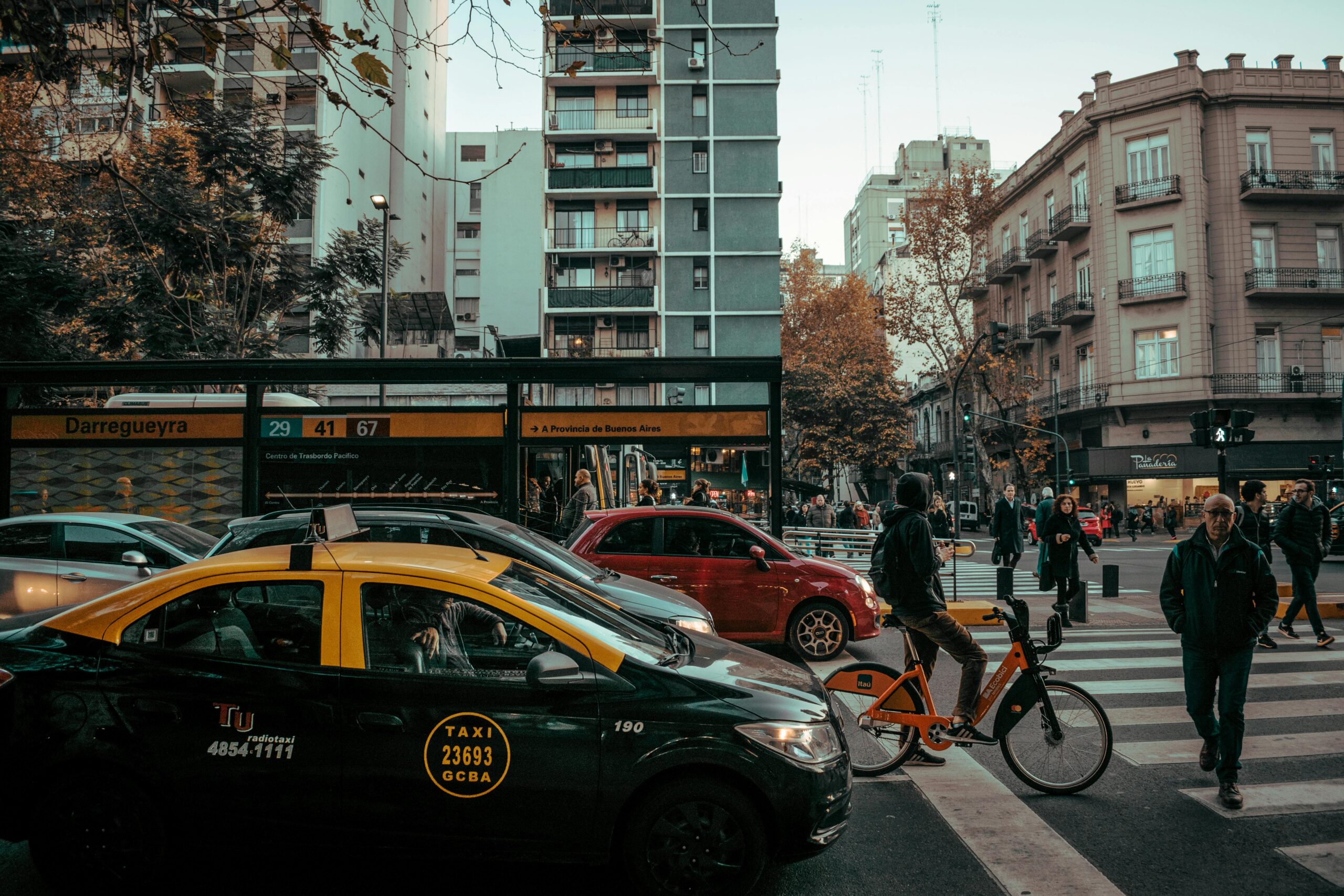
What actually keeps you safe in any car here
The advice that matters is not app specific:
- Check the plate before you get in, not after. Every time, including when you are tired.
- Sit in the back, and keep your bag with you rather than in the boot when it is a short trip.
- Share your trip with someone, which the apps make easy and which costs you nothing.
- Do not stand on the street with your phone out looking lost while you wait, particularly at night. Wait inside a cafe, a hotel lobby or a shop.
- Have the address written down in Spanish, including the neighbourhood. Buenos Aires has repeated street names across different areas.
- Do not accept a ride from someone who approaches you offering one, at the airport or anywhere else. This is the one piece of advice that is genuinely about avoiding a scam.
That last point is the real airport risk, and it predates ride apps entirely: unofficial drivers working arrivals halls, offering a ride to a tired passenger who has just landed. It is not a rumour among travellers either. The airport's own website says it plainly, in one line: do not accept transport services offered out loud. The answer is the same as it has always been: only get into a car you arranged, with a driver whose name you already know. We covered the classic taxi version of this in our guide to safe taxis at the Buenos Aires airport, and the broader picture in is Buenos Aires safe for solo travelers.
When a ride app is the wrong tool
There are four situations where we would tell a friend not to bother with the app, and we would say the same thing if we were in the transfer business or not:
1. Arriving on an international flight. You do not want your first decision in a new country to be a negotiation. A pre booked car with a driver holding a sign, tracking your flight, is the whole point.
2. Leaving for an international flight. Ezeiza is well outside the city and traffic is unpredictable. A missed flight costs many times what the ride saved.
3. Travelling with luggage, children, or a group. Cars in the app are cars. A family of five with suitcases is a different vehicle, and finding it live at the kerb is not fun.
4. Anything with a schedule attached. A cruise departure, a ferry to Colonia, a connecting flight. The moment a fixed time is involved, an app that may or may not find a driver is the wrong instrument.
So what do we do differently
Our answer to all four of those is boring and it is the product: a private transfer, booked in advance, at a fixed price agreed before you fly, with a driver who tracks the flight and waits inside the terminal with your name on a sign.
It costs more than the app on a good day. On a bad day, which is the one you cannot predict from another continent, it is the difference between arriving and coping.
For everything else, once you are in the city, with a working phone and no schedule to keep: use the app, check the plate, sit in the back. It is a normal tool for normal trips.
Frequently Asked Questions
Is Uber safe in Buenos Aires for tourists?
For ordinary trips inside the city, it is broadly comparable to using a ride app in other large cities, with the same precautions: verify the plate, share your trip, avoid waiting on the street at night. The friction is concentrated at the airport, not in the ride itself.
Is Uber legal in Buenos Aires?
Yes. A city court ordered it suspended in 2016, a day after it launched, but the service kept running regardless. In May 2026 an appeals court ended a ten year case by ruling that app drivers must meet the same requirements as taxi and hire car drivers, professional licence and passenger transport insurance included, and the judges were explicit that they were not prohibiting the platforms. The city government announced its regularisation rules within weeks, and a national decree put the transport secretariat in charge of mobility platforms. A specific law from the city legislature is still pending, and the court's regime lapses once it passes. So the accurate summary for a traveller is not "banned" and not fully settled either: legal, in universal use, and still being regulated.
Can I take a ride app from Ezeiza airport?
Yes, and there are signposted pickup points for app cars. They were reorganised in December 2025 and Cabify’s moved again in June 2026, and the airport's own website does not list the apps at all, so follow the app's instructions on the day rather than any written directions, including these.
What is the safest way to get from the airport to the city?
A pre booked private transfer or one of the official counters in Terminal A arrivals. What to avoid, and this is the actual scam risk, is accepting a ride from someone who approaches you in the arrivals hall. The airport itself warns against exactly that.
Do I need cash for taxis in Buenos Aires?
Not the way older guides suggest. The exchange rate gap that used to punish foreign card payments closed in April 2025. Carry some local cash as a fallback, not as a strategy.
The honest summary
Ride apps in Buenos Aires are fine for what they are: a convenient way to cross a big city when nothing important depends on the outcome. The moment something does depend on it, an arrival, a departure, a ferry, a family with bags, the calculation changes and it is no longer about safety in the dramatic sense. It is about not wanting the first or last hour of your trip to be the part you tell people about.