TRANSFERS · CRUISE LOGISTICS · 2026
Your ship berths at seven, the gangway opens at eight, and your flight leaves at nine at night. What happens in between is a logistics question, and it has a straightforward answer.

Arriving in Buenos Aires by sea is the good part. Whether you are coming back from the Drake Passage or starting a run down to Cape Horn, the city shows itself from the river first: the cranes of Puerto Nuevo, the towers of Retiro behind them, and the low brown water of the Río de la Plata that gave the country its name.
Then the gangway opens, you collect a suitcase that has been packed for three weeks of expedition weather, and the day turns practical. We move cruise passengers in and out of this terminal every season, and the questions are always the same four: where am I, can I walk, how long is the drive, and what do I do with the eight hours between the ship and the flight.
Where is the Benito Quinquela Martín cruise terminal?
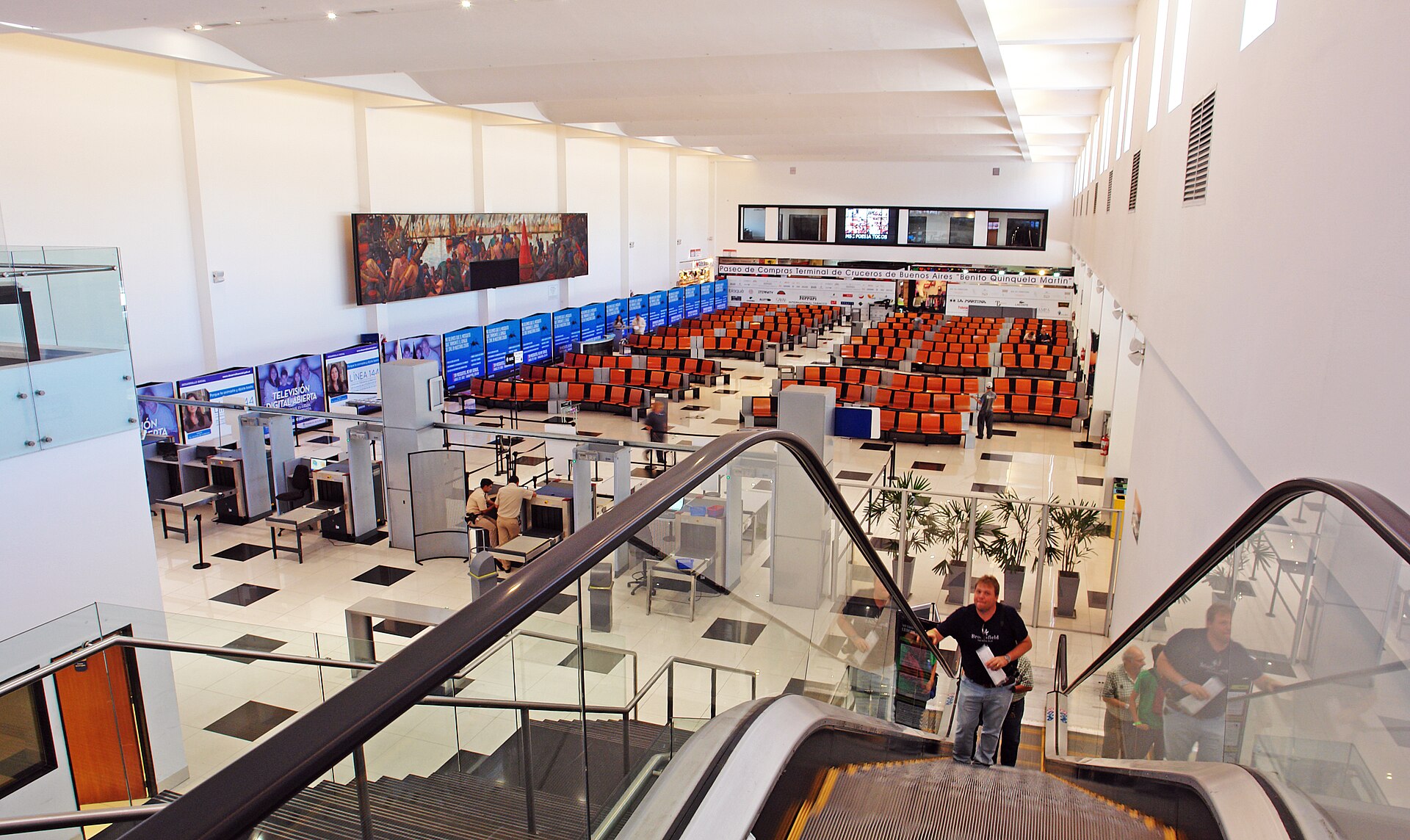
The passenger terminal, named after the painter of La Boca's dockworkers, sits inside Puerto Nuevo, the working port in the neighbourhood of Retiro.
→ AV. RAMÓN S. CASTILLO AND AV. DE LOS INMIGRANTES, PUERTO NUEVO / RETIRO
It is a serious building: 12,786 square metres, 72 counters in two check-in areas for immigration, customs and the shipping lines, a waiting hall for 2,000 people, a baggage hall for 12,000 suitcases, free wifi, a bank and a currency exchange, and dedicated parking bays for coaches, taxis and hire cars. On its busiest days it is built to handle up to 12,000 passengers.
What surrounds it matters as much as what is inside it. The terminal sits in the middle of an active cargo port: container yards, truck lanes, rail sidings. It does not open onto a promenade or a shopping street. Everything about your departure from the port is shaped by that one fact.
Can you walk out of the cruise port?
You can. It is just a bad idea with luggage.
The nearest station, Retiro, is under a kilometre away, roughly a fifteen minute walk in a straight line. The straight line is the problem: the route out of the passenger area runs along port roads built for freight traffic. Add two suitcases and a duffel bag of parkas and it stops being a walk and becomes an obstacle course.
What actually happens on disembarkation morning is simpler. You come off the ship, clear the hall, and step out at the vehicle pick-up area, where coaches, taxis and pre-booked cars are waiting. If you are counting on a shuttle into the city, ask your cruise line whether it runs one.
How far is the terminal from Ezeiza and Aeroparque?
This is the number that decides your morning.
Aeroparque Jorge Newbery (AEP), which handles domestic flights to Iguazú, Ushuaia, Bariloche and El Calafate along with regional routes, is about 5 to 6 kilometres from the terminal, up the Costanera. Depending on traffic, that is a 25 to 35 minute drive. For a flight out of Aeroparque, we recommend leaving 3 hours before an international flight and 2.5 hours before a domestic one.
Ministro Pistarini, or Ezeiza (EZE), where the long-haul flights to North America and Europe leave from, is about 35 kilometres southwest of the city, out at kilometre 33.5 of the Riccheri motorway. Depending on traffic, the drive from the port is 40 to 80 minutes.
Our standing advice for an international departure from Ezeiza is to leave the port four hours before take-off (three and a half for a domestic flight). That is not caution for its own sake: it is one drive, on one motorway, with no train alternative if the road is blocked.
What the ride costs. A private transfer between the terminal and Ezeiza or Aeroparque is USD 52 in a Comfort Car for two and USD 161 in a Van H1 for six, in either direction. From the terminal to a hotel in the city it is USD 35 in the car and USD 95 in the van; from the hotel to the terminal, USD 30 and USD 95. Prices are per vehicle, not per person, the same at any hour, with 60 minutes of waiting at the port included. Every vehicle, plus private shore excursions for a port day, is on our cruise stop page.
Need a ride from the pier? Give us your ship's docking time and we meet you at the Quinquela Martín arrivals gate with a sign, handle the luggage and drive you straight to Ezeiza, Aeroparque or your hotel. Book your private cruise transfer.
What are your options for getting out of the port?
When two or three ships turn around on the same morning, several thousand people leave the terminal inside a couple of hours. Everyone wants a car at once. Your options, in the order we would rank them for someone travelling with real luggage:
1. A pre-booked private transfer. A driver waiting at the luggage exit with your name, a fixed price agreed in advance, help with the bags, and a car that leaves when you do. No queue, no negotiation, no cash question.
2. The official taxi rank. There are taxi bays at the terminal and the system works. The variable is the queue: on a single-ship morning it moves, on a three-ship morning it is the slowest part of your day.
3. Public transport. Retiro's stations and bus stops are close on a map and far in practice, for the reasons above. With luggage, treat this as a non-option.
What if you have eight hours before your flight?
Most ships dock at 7 or 8 in the morning. If your flight out of Ezeiza leaves in the evening, the gap in between is the most common situation we handle all season, and spending it in a departures lounge is a waste of a city.
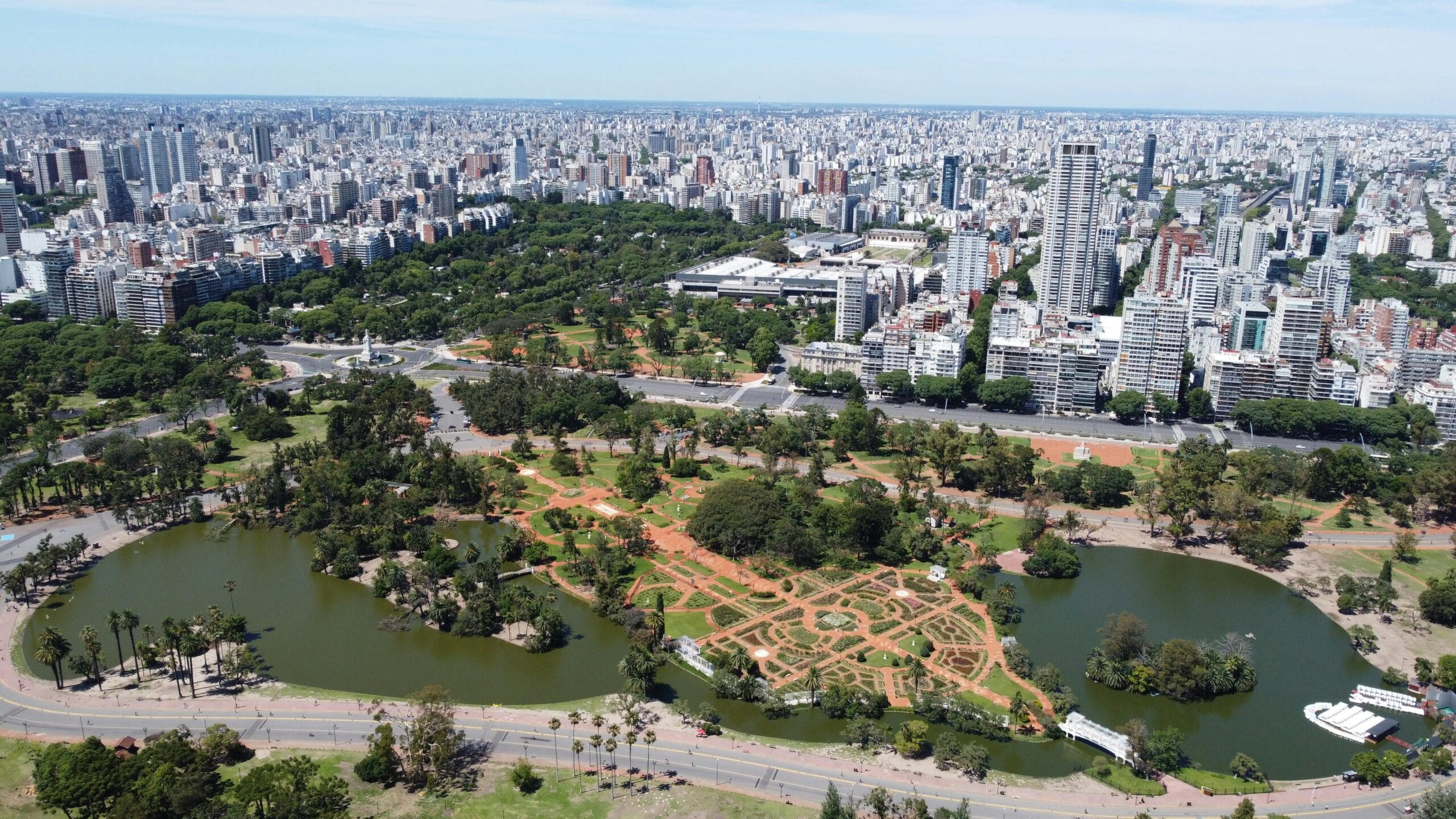
The alternative is a transfer with the day attached to it: the bags stay locked in the car, and you spend the hours where you actually want to be. Lunch in Puerto Madero, a walk through San Telmo, the Recoleta cemetery, the rose garden in Palermo, a stop for coffee somewhere with a marble counter. When the afternoon runs out, the same driver takes you to Ezeiza with time to spare. You never touch your luggage in between.
Cruise port transport, compared
| Option | Drive time to EZE | Luggage | On a multi-ship morning |
|---|---|---|---|
| Pre-booked private transfer | 40 to 80 min | Door to door, driver handles it | Unaffected: the car is already yours |
| Official taxi rank | 40 to 80 min plus the queue | You manage it to the kerb | The queue is the bottleneck |
| Public transport | Not realistic with bags | On foot along port roads | Worse |
Frequently Asked Questions
How far is the Buenos Aires cruise terminal from Ezeiza airport?
About 35 kilometres. The drive takes 40 to 80 minutes depending on traffic. For an international flight, leave the port with a four hour cushion.
Can you walk from the cruise terminal into the city?
It is possible, Retiro is under a kilometre away, but the route runs along port roads built for trucks. With luggage, take a vehicle from the terminal's pick-up area instead.
Are there taxis at the Buenos Aires cruise terminal?
Yes, there is an official taxi rank at the terminal. On mornings when several ships disembark at once, expect a long queue.
The last kilometre of a long voyage
Disembarking should feel like the next chapter of the trip, not a problem to solve on four hours of sleep. Book the ride before the ship docks, and the port becomes what it should be: the place where Buenos Aires starts.
Reserve your cruise port transfer. Message us on WhatsApp at +54 9 11 2404-0448 or book online for a private car from the Quinquela Martín terminal to Ezeiza, Aeroparque or your hotel.