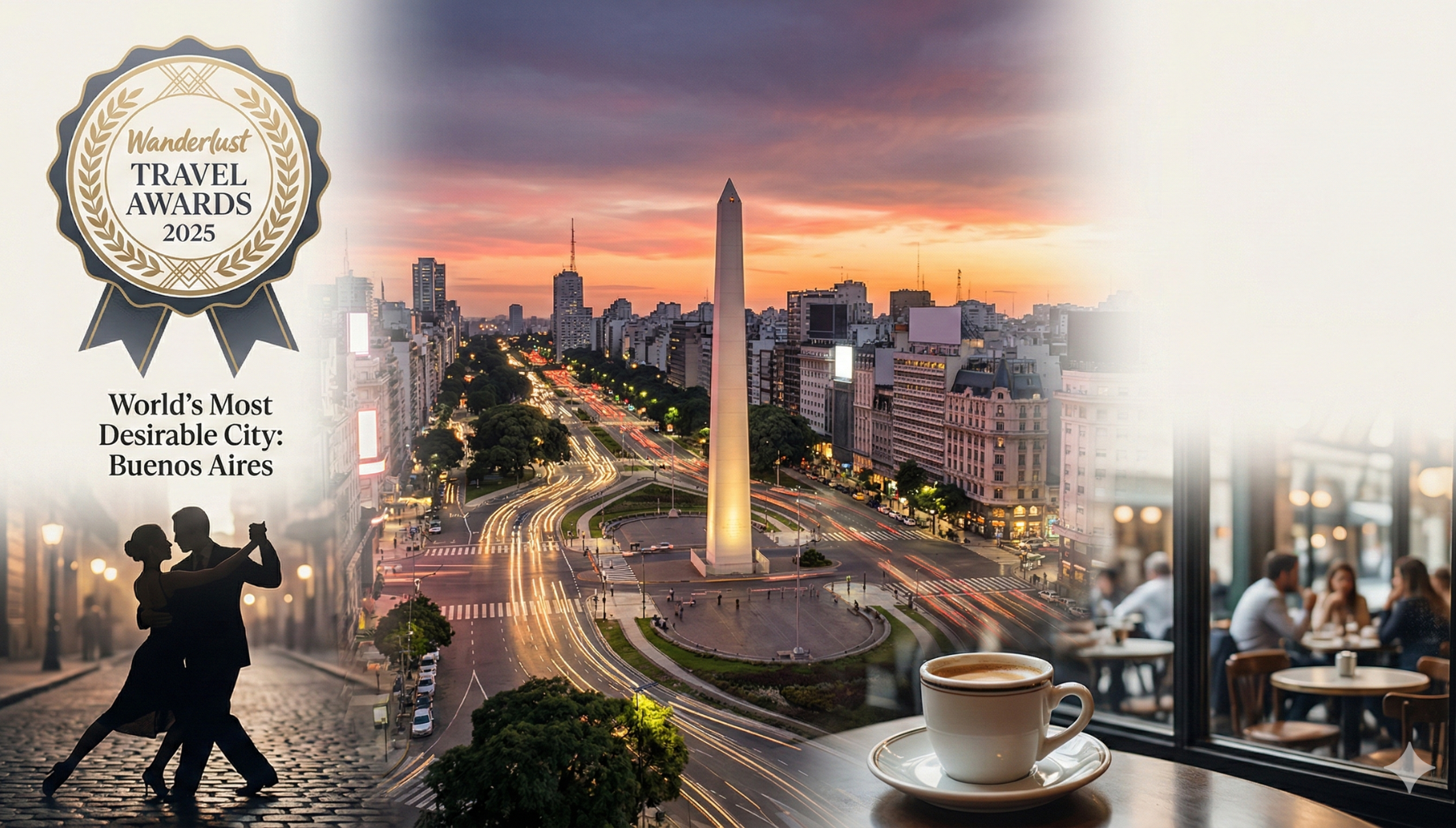
Why 208,000 readers ranked it above Tokyo and Sydney, and how to experience it like a local through a private, personalized tour.
Quick summary: Buenos Aires won Gold as Wanderlust’s Most Desirable City (World) in 2025 after 208,000 readers cast 4.8 million votes. Travelers praised its neighborhood energy, tango culture, food renaissance, year-round arts, and the warmth of porteños.
What the Wanderlust Awards Actually Measure (and Why This Win Matters)
Not all travel rankings are created equal. The Wanderlust Reader Travel Awards stand out because they are voted entirely by real travelers, not industry panels, not sponsored committees. Published by Wanderlust, one of the UK’s best-known travel magazines, the awards have been running for 24 years and represent one of the most honest barometers of global travel desire.
In 2025, the ceremony was held at the iconic National Gallery in London. The result? Buenos Aires climbed six positions from the previous year to claim the Gold award in the World’s Most Desirable City category, the highest recognition in the rankings.
How Many People Voted, and What They Said
More than 208,000 readers participated, casting 4.8 million votes across all categories. Readers highlighted Buenos Aires for its creative energy, cultural depth, gastronomic scene and, above all, the warmth of its people. These aren’t marketing talking points: they are the words of experienced travelers who compared it against every major destination on the planet and still chose Buenos Aires as the best city to visit in 2025.
The Top 10 Most Desirable Cities in 2025
According to Wanderlust’s official results:
- Buenos Aires 🥇
- Tokyo
- Sydney
- Cape Town
- Vancouver
- Singapore
- Marrakech
- Rio de Janeiro
- Quito
- Hong Kong
Why Travelers Chose Buenos Aires: The 5 Reasons Repeated by Voters
Neighborhood Energy: Every Block Tells a Different Story
San Telmo with its antique markets and cobblestone streets. Palermo with its restaurants, design studios and weekend fairs. Recoleta with its European-style architecture and cultural centers. La Boca with its street murals and percussion music. Buenos Aires is not one city, it’s a collection of distinct worlds, each with its own rhythm and identity. Travelers who come for a week often find themselves planning to come back before they’ve even left. It’s consistently ranked among the top city breaks in South America, and increasingly, the world.
Tango Beyond the Show: Milongas and Living Culture
Tango in Buenos Aires is not a performance for tourists, it’s a living social practice. Readers repeatedly highlighted this distinction. Yes, there are polished dinner shows that offer a spectacular introduction to the form. But the real experience happens at milongas: neighborhood dance halls where locals of all ages gather late at night, where strangers invite each other to dance with a nod, and where the music never feels like a soundtrack, it feels like a conversation.
The New Argentine Food Wave
Buenos Aires is in the middle of a genuine culinary renaissance. A generation of young chefs is reinterpreting classic Argentine ingredients, beef, offal, corn, river fish, Patagonian lamb, with technique, creativity and a strong sense of local identity. Local cultural statistics often cited about the city include more than 7,000 restaurants, ranging from century-old bodegones to tasting-menu destinations that rival anything in Europe. For food travelers, Buenos Aires is not a stop on the way somewhere else, it is the destination.
A City You Can Measure in Culture
Local figures frequently cited about Buenos Aires: 287 active theaters, 380 bookstores and 150 museums. The cultural calendar runs year-round, with free museum Sundays, outdoor film screenings, literary festivals and a tango festival in August that takes over entire neighborhoods. Few cities on earth offer this density of cultural life at this price point, which is part of why it’s become one of the most attractive cities in the world for culturally-driven travelers.
The People: Warmth as a Travel Experience
Of all the reasons cited by readers, this one appeared most consistently: the people. Buenos Aires locals, porteños, have a reputation for being passionate, opinionated and genuinely interested in whoever walks through their door. That combination of warmth and intellectual curiosity is rare, and it’s what transforms a good trip into an unforgettable one.
How to Experience “The World’s Most Desirable City” Like a Local
Where to Stay by Vibe
- Palermo Soho / Hollywood , Best for first-timers, foodies and design lovers. Tree-lined streets, excellent restaurant density, close to parks and weekend markets.
- San Telmo , Best for history, atmosphere and nightlife. The oldest neighborhood in the city, with one of the city’s best-known antique markets (every Sunday) and a tango scene that feels genuinely lived-in.
- Recoleta , Best for classic Buenos Aires and cultural institutions. Home to the famous cemetery, the Museum of Fine Arts and some of the city’s most beautiful early 20th-century architecture.
- Belgrano / Núñez , Best for a residential, local feel away from the tourist circuit. Quieter, more affordable, and a favorite among repeat visitors who want to feel like they actually live here.
48-Hour Itinerary: Buenos Aires Essentials
Day 1, The Historic City
Start in San Telmo: coffee at a café notable, a slow walk through the Sunday market if timing allows, then head to La Boca to see Caminito and the street art. Afternoon in Recoleta, the cemetery is genuinely worth two hours. Evening: dinner in Palermo, then a milonga if you’re feeling ready.
Day 2, The Living City
Morning at the Palermo weekend fair. Lunch at a classic parrilla. Afternoon exploring Colegiales or Villa Crespo, the quieter, more local side of Palermo. Evening: a wine bar in San Telmo, then a late dinner the way porteños do it, after 9pm.
Tango: Show vs. Milonga, What to Choose
- Choose a dinner show if: it’s your first night, you want context and spectacle before diving deeper, or you’re traveling with people who are curious but not yet committed.
- Choose a milonga if: you want the real social experience, you’re open to dancing with strangers, or you’re a repeat visitor who already has the postcard version. Milongas typically start after midnight and go until 5am. Dress code matters, ask before you go.
- Avoid: tourist packages near the main squares that bundle tango + steak + wine at aggressive prices. The quality is usually low and the experience is designed to move people in and out quickly.
Food Shortlist: Where to Eat in Buenos Aires
- Classic parrilla: Don Julio (Palermo) or La Carnicería for a modern take
- Café notable: Café Tortoni (historic, worth it once) or El Federal in San Telmo for a more local feel
- Fine dining: Tegui or Mishiguene for contemporary Argentine cuisine
- Wine bar: Verne Club or Oporto for natural wines and small plates
- Market: Mercado de San Telmo for lunch and grazing
Travel Tips: Quick Answers
Is Buenos Aires Safe for Tourists?
Buenos Aires is a large city and normal urban awareness applies. The main visitor neighborhoods, Palermo, Recoleta, San Telmo, Puerto Madero, are generally safe during the day and evening. Avoid displaying expensive equipment openly, and ask your accommodation or tour guide about current conditions, as these can shift.
Getting Around Buenos Aires
The SUBE card covers buses and the subway (subte), easy to get at kiosks near most stations. For neighborhoods not on the metro line, buses are frequent and cheap. For late-night travel, use ride-hailing apps such as Cabify (and other local options available at the time of your visit) rather than unmarked street taxis.
Best Time to Visit Buenos Aires
- Spring (September–November): Ideal. Mild temperatures, jacaranda trees in bloom, the city at its most photogenic.
- Fall (March–May): Equally beautiful, with warm evenings and a strong cultural calendar.
- Summer (December–February): Hot and humid. Many locals leave in January, quieter streets but some venues closed.
- Winter (June–August): Cold but lively. The Buenos Aires Tango Festival in August is one of the best times to visit if tango is your priority.
FAQ
Is Buenos Aires safe for tourists? Yes, with normal urban awareness. Stick to the main visitor neighborhoods, use apps for late-night transport, and ask locals or your guide about current conditions.
What’s the best neighborhood to stay in Buenos Aires? Palermo for first-timers and food lovers. San Telmo for atmosphere and nightlife. Recoleta for classic architecture and culture. Belgrano for a quieter, more residential feel.
Is a tango show worth it, or should I go to a milonga? Ideally both, in that order. A dinner show gives you context; a milonga gives you the real thing. If you only have one night, go to the milonga.
What’s the best time to visit Buenos Aires? Spring (September–November) or fall (March–May). August is ideal if tango is your main reason for going.
What’s the best way to experience Buenos Aires beyond the tourist circuit? Skip the generic group tours. A private, personalized tour built around your interests, food, tango, architecture, markets, will take you to places that don’t appear in any guidebook.
Want to Experience It Without the Guesswork?
Buenos Aires rewards curiosity, but it also punishes generic itineraries. The city’s best experiences don’t happen on the main tourist circuit: they happen in the right neighborhood at the right hour, with someone who knows which door to knock on.
That’s what a private, personalized Buenos Aires tour offers:
- Tailored to your interests , food, tango, architecture, markets, or all of the above
- Flexible pace + local timing , where to be, when, and why it matters
- No-guidebook places , reservations, hidden spots and local knowledge you won’t find online
Not a checklist. Not a group of twenty people following an umbrella. A tour built around what you actually want to see, eat and feel.
Want a Buenos Aires that doesn’t feel like a checklist? Get in touch and we’ll build your experience from scratch.
Sources: Wanderlust Magazine · Reader Travel Awards 2025 · Award Winners Page · Results Post · Top 10 Most Desirable Cities 2025