CULTURE · CAFÉS NOTABLES · 2026
The city protects its oldest cafés by law. Six of them will pour you a cortado this afternoon, and the seventh, the most beautiful of all, you have to win a place for.
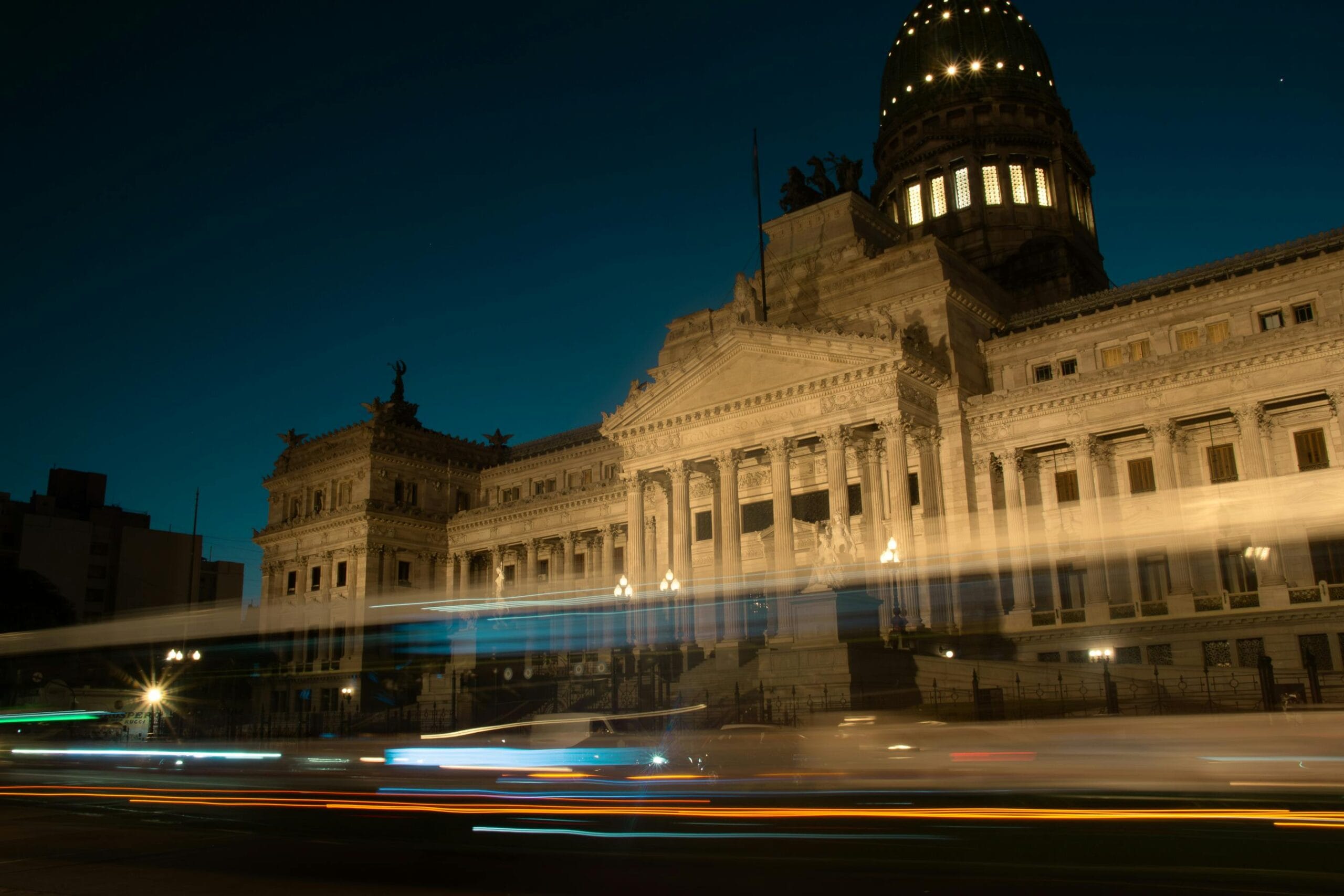
In Buenos Aires a café is not where you buy coffee. It is where you sit for two hours over one cortado, where a newspaper gets read cover to cover, and where a waiter who has worked the same floor for thirty years will not hurry you. The city recognised this in 1998 with an official category, the Cafés Notables, and since 2015 it gives the listed ones a tax break for as long as they keep their name, their rooms and their character.
There are dozens on the list. These seven are the ones we send people to, in the order that makes sense for a visitor: the six you can walk into today, and then the one that is worth the paperwork.
01 · CAFÉ TORTONI
MONSERRAT · SINCE 1858 · THE OLDEST
The one everyone goes to, and it has earned it
The oldest café still working in Buenos Aires, founded in 1858 by a Frenchman named Jean Touan and named after a café in Paris. It did not start here: the original was at Esmeralda and Rivadavia, and it moved to Avenida de Mayo later, which is why the building you sit in is grander than an 1858 café would have been.
Its real claim is downstairs. In 1926 the painter Benito Quinquela Martín founded La Peña, the Agrupación de Gente de Arte y Letras, in the cellar, and for years it was the most famous gathering of artists and writers in the city. Alfonsina Storni was one of its regulars. Borges came. So did Gardel.
It is also, now, the most touristed café in Buenos Aires, with a queue on the pavement most of the day. Go early or go on a weekday morning, order the hot chocolate with churros, and accept that you are one of many. It has earned the crowd.
→ AV. DE MAYO 825, MONSERRAT
02 · LAS VIOLETAS
ALMAGRO · SINCE 1884 · AFTERNOON TEA
Stained glass and a proper tea
Opened in 1884 on the corner of Rivadavia and Medrano, and rebuilt in the 1920s into what you see now: double-height rooms, curved glass, Italian marble floors, furniture brought from Paris, and the stained glass that everyone photographs, installed in 1928 and made from French glass by the glass artist Antonio Estruch.
Alfonsina Storni was a regular. Roberto Arlt drank his coffee here and put the place, in detail, into his story Noche Terrible. Then, in 1998, it closed, and stayed shut for three years until the city declared it a protected historic site and it reopened in 2001, which is the only reason the windows still exist.
Afternoon tea is the institution: tiered stands, sandwiches, scones, pastries, waiters in bow ties who have been doing this a long time. It is a forty minute detour from the tourist centre and the least touristed grand café in the city, which is the trade. If tea is what you are after and you would rather not leave Recoleta, the Palacio Duhau serves its own version inside a 1934 palace, which we cover in the Belle Époque palaces guide.
→ AV. RIVADAVIA 3899, ALMAGRO
03 · LOS GALGOS
SAN NICOLÁS · SINCE 1930 · BAR NOTABLE
Properly old and genuinely good
A corner bar since 1930, in a building that had spent the previous decade as the commercial premises of the Singer sewing machine company. The Asturian who turned it into a café liked greyhound racing, hence the name. The Ramos family took over the counter in 1948 and kept it for decades, and Discépolo, Pugliese and Troilo drank here; much later, so did Luca Prodan.
When Horacio Ramos, the last of the brothers, died, it closed, and it stayed shut until December 2015, when it reopened in the hands of Julián Díaz and the designer Flor Capella, the pair behind the bar 878, who restored it with what was there rather than a nostalgic reproduction of it. The result is the rare case of a bar notable that is both properly old and genuinely good: house vermouth, real coffee, and a toasted ham and cheese medialuna at the wooden bar.
One thing to know: it opens at 8:30 in the morning from Monday to Friday, but on Saturday it does not open until 17:00, and Sunday is not on the board. It is not a weekend breakfast.
→ AV. CALLAO 501, SAN NICOLÁS
04 · CAFÉ LA POESÍA
SAN TELMO · SINCE 1982 · POETS' CORNER
Where the Grupo de los 7 was founded
On a cobbled corner in San Telmo, opened in 1982 by the poet and journalist Rubén Derlis. Derlis belonged to the Generación del 60, the circle around Juan Gelman, Paco Urondo, Olga Orozco and Alejandra Pizarnik, and within a few years he had turned the bar into their meeting room. The Grupo de los 7 was founded at these tables.
It closed in 1988 and came back years later under new hands, with the walls still covered in framed portraits of poets. One table carries a small bronze plaque: it is where Horacio Ferrer met Lucía Michelli, and wrote the poem "Lulú" for her, which later became a waltz.
Go in the late afternoon, order a glass of red, and take something to read. It is a few cobbled blocks from Plaza Dorrego, so it slots neatly into a San Telmo afternoon.
→ CHILE 502, SAN TELMO
05 · BAR PLAZA DORREGO
SAN TELMO · SINCE 1880 · REOPENED 2026
Rebuilt plank by plank, and open again this year
It began in 1880 as a neighbourhood almacén, a general store with a drinks counter, on the corner of Defensa and Humberto Primo, facing Plaza Dorrego, and it never entirely stopped being one. In 1975 it was where Jorge Luis Borges and Ernesto Sabato sat down together again after twenty years of not speaking.
Then it closed, and stayed dark for years. It reopened in March 2026 under Pablo Durán, the man who rescued Café La Poesía a few blocks away, after a restoration that put back what was there rather than replacing it: the carved wooden bar, rotten through, was taken apart, rebuilt section by section and put back with the customers' inscriptions still on it; the checkerboard floor was kept and the original tables and chairs went to a carpentry workshop and came back; only the kitchen is new.
It is on the Bares Notables list, and it runs from 8:00 in the morning until 2:00 at night on picadas, homemade pasta, sandwiches and coffee. On Sundays the antiques fair takes over the square outside and the tables on the pavement are the best seats in San Telmo; on any other day, the bar itself is the reason to come.
→ DEFENSA Y HUMBERTO PRIMO, SAN TELMO
06 · LA FARMACIA
FLORES · SINCE 1910 · BAR NOTABLE
A chemist's shop that never quite stopped being one
Out in Flores, well off any tourist route, on the corner of Directorio and Rivera Indarte. The Farmacia Santa Elena opened here in 1910 and was still filling prescriptions at the end of the century; when it closed, the pharmacist's family kept the room instead of selling it, and in the early 2000s it reopened as a café with the pharmacy left in place. The wooden cabinets and shelving are the chemist's, the old jars still line them, the precision scales are still on the counter, and the mosaic floor is the pharmacy's. In 2010 the city put it on the Bares Notables list, for the building and for what was kept inside it.
The light is low, the room is warm, and the menu is the classic bar notable one: a picada, savoury pancakes, a fondue if you are staying. It is the furthest from the centre of anything on this list, and the least likely to have another visitor in it.
One thing to know: it opens Monday to Saturday, from 8:00 to midnight, and Sunday is not on the board, which is exactly the day most visitors have free.
→ AV. DIRECTORIO, CORNER OF RIVERA INDARTE, FLORES
Doing all seven in a day? They are spread from Flores to Balvanera and the driving between them is the tiring part. Book a private car for the afternoon and skip the logistics.
07 · CONFITERÍA DEL MOLINO
BALVANERA · 1916 · GUIDED TOURS ONLY
Read this before you go
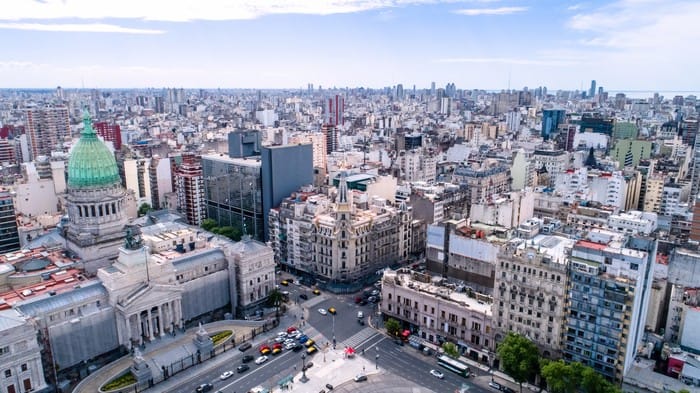
The most spectacular building on this list, and the one you cannot simply walk into. Read this part before you go.
Standing directly opposite the National Congress, the Molino was designed by the Italian-born architect Francesco Gianotti, commissioned in 1915 and opened on 9 July 1916, the centenary of Argentine independence, and it is one of the great Art Nouveau buildings in Argentina: a corner tower topped with a windmill ornament, Art Nouveau stained glass, and reinforced concrete at a moment when the city was still building in brick. Its name comes from the Lorea mill, the first flour mill in Buenos Aires, which stood nearby.
It closed in 1997 and spent two decades empty. The state restoration began in 2018 and is still under way, which is the crucial point: the Molino is not an operating café. You cannot turn up and order a coffee.
How you actually get in: the building runs free guided tours, on a few weekdays each week, at 10:00 and 14:00, and the only way on to one is to register in advance at inscripciones-delmolino.hcdn.gob.ar. Two things matter more than the timetable. Places are released every Friday at 12:00, and they are gone almost immediately: for most of any given week the site simply reads cupos agotados, sold out. So do not plan around a date, plan around a Friday noon, and check the site again before you travel, because the Commission that runs the building has already changed the booking system once.
The tour now covers the first-floor salon, one of the basements and the ground-floor confitería, where a courtesy coffee is served at the end. That coffee, inside that room, is the closest anyone gets today to the confitería as it was.
→ AV. RIVADAVIA 1815, BALVANERA
The seven, at a glance
| Café | Since | Neighbourhood | The practical bit |
|---|---|---|---|
| Café Tortoni | 1858 | Monserrat | Open daily, expect a queue, go early |
| Las Violetas | 1884 | Almagro | Afternoon tea, worth the detour, least touristed |
| Los Galgos | 1930 | San Nicolás | Saturday opens at 17:00, no Sunday |
| Café La Poesía | 1982 | San Telmo | Late afternoon, quiet, a few blocks from Plaza Dorrego |
| Bar Plaza Dorrego | 1880 | San Telmo | Reopened March 2026, 8:00 to 2:00, tables on the square |
| La Farmacia | 1910 | Flores | Monday to Saturday only, furthest out, nobody else will be there |
| Confitería del Molino | 1916 | Balvanera | Free guided tour only, places released Fridays at 12:00 |
What you are actually ordering
A cortado is espresso cut with a little hot milk, and it is what most people drink most of the day. A lágrima is the reverse: milk with a tear of coffee. A café con leche is a breakfast drink and ordering one after lunch marks you out immediately, though nobody will say anything. Whatever you order, it arrives with a glass of soda water and usually a small biscuit, and nobody expects you to leave. The longer version of all this, including what the third wave has changed and what it has not, is in our piece on the ritual of coffee in Buenos Aires.
Questions we get asked
What is a café notable in Buenos Aires?
It is a legal category, not a marketing one. Under a 1998 city law, a commission keeps a catalogue of bars and cafés whose age, architecture or cultural history make them worth preserving, and since 2015 the listed ones get a tax break that they lose if they change their name, their character or their facade. It is an incentive, not a guarantee: Los Galgos, on this list, closed in 2015 before it was rescued. There are dozens on the list; the seven here are the ones we send people to.
Can you have a coffee at the Confitería del Molino?
Not on your own. The building is still being restored and is not an operating café, so the only way in is a free guided tour booked in advance at inscripciones-delmolino.hcdn.gob.ar. A courtesy coffee is served downstairs as part of the tour. Places are released every Friday at 12:00 and sell out fast.
Which historic café in Buenos Aires is worth it without the crowds?
Las Violetas, in Almagro. It is about forty minutes from the tourist centre, which is exactly why it stays calm, and the 1884 room with its 1928 stained glass is the equal of anything downtown. Afternoon tea there is the reason most people make the trip. If you want emptier still, La Farmacia in Flores is a former chemist's shop with the cabinets and jars left in place, open Monday to Saturday.
Is the Café Tortoni worth visiting?
Yes, but go early. It is the oldest café in Buenos Aires, open daily from 8:00 to 21:00, and it is also the most touristed, with a queue on the pavement for most of the day. A weekday morning is the difference between a nice hour and a wait.
Plan the afternoon
Plan an afternoon around the cafés. Message us on WhatsApp at +54 9 11 2404-0448 or book a private car and see six of them without spending the day in traffic.