ARCHITECTURE · PRIVATE TOURS · 2026
Between the shaded avenues of Retiro and the marble staircases of Recoleta, four French châteaux survive from the years when Argentina had more money than it knew what to do with.
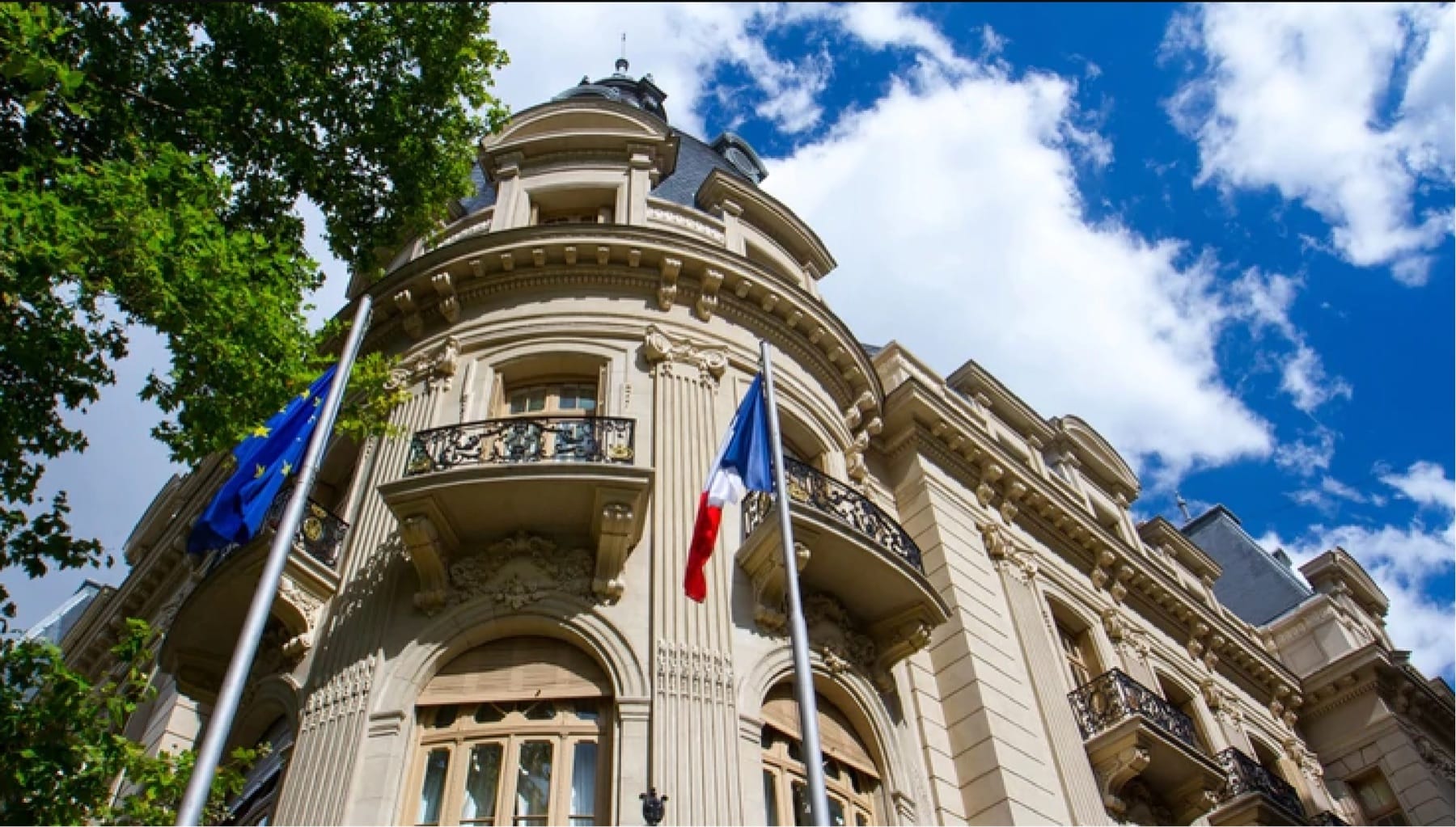
Between 1880 and the Great Depression, Argentine families made fortunes from beef and grain and spent a good part of them on architecture. They hired French architects, imported the stone, the panelling and sometimes the craftsmen, and built private houses on a scale that startled European visitors. Most of those houses are gone. The survivors are the ones that found an institution to take them over: the palace above, designed in the early 1900s by the French architect Paul Pater for Daniel Ortiz Basualdo, has been the French embassy since 1939, which is the only reason it is still intact.
Four of the best sit within a short drive of each other, and each one solved the problem of survival differently: one became a military club, one a ministry, one a museum, one a hotel. That last detail is the useful one, because it decides whether you can get in. Below is what each palace is now, and what visiting actually involves in 2026. We drive architecture guests along this route regularly, and the question that ruins itineraries is always the same one: assuming a building is open because it is famous.
01 · PALACIO PAZ
RETIRO · CÍRCULO MILITAR · 140 ROOMS
The biggest of them all, and you can walk through it
Built between 1902 and 1914 for José C. Paz, the statesman who founded the newspaper La Prensa, and designed by the French architect Louis-Marie Henri Sortais, who never once travelled to Buenos Aires to see it. It is the largest of the four by some distance: over 12,000 square metres and 140 rooms across four levels. The centrepiece is the Great Hall of Honour, a circular room under a stained-glass dome, lined with precious marbles.
Twelve years of building was too long for its owner. Paz died in 1912, two years before it was finished, and never lived in it. Since 1938 the building has housed the Círculo Militar, the officers' club, which is why it survived intact when its contemporaries were demolished. The Museo de Armas de la Nación, a collection of arms running from the Middle Ages to the Falklands, occupies part of it.
Visiting: this is the one of the four you can properly walk through, and guided tours do run. The catch is that the schedule moves, and the Círculo Militar’s own site sends you to Instagram (@palaciopazok) for current dates and hours rather than publishing a fixed schedule. Confirm directly before you build an afternoon around it. The Museo de Armas inside the same building keeps its own hours, Monday to Thursday 10:00 to 16:00, and answers at museodearmasdelanacion@circulomilitar.org.
→ AV. SANTA FE 750, RETIRO
02 · PALACIO SAN MARTÍN
RETIRO · FOREIGN MINISTRY · 1905 TO 1909
Three houses behind one facade
Facing Plaza San Martín, this was built between 1905 and 1909 for Mercedes Castellanos de Anchorena, to a design by the Norwegian-Argentine architect Alejandro Christophersen. It looks like one building and is in fact three: three separate family residences for the matriarch and her sons, arranged behind a single Beaux-Arts facade around a paved carriage courtyard. The Foreign Ministry calls it Christophersen's masterpiece, and the slate mansard with its porthole windows is the detail that gives the period away.
The state bought it in 1936 for the Foreign Ministry. When new offices opened in 1993 the administrative staff moved out, and the palace became what it remains: the ceremonial seat of the Ministry, used for state receptions and treaty signings.
Visiting: the guided tours are suspended. The Ministry's own page says so in as many words, with no reopening date announced. For now this is a facade to admire from the square, not an interior to book, and any guide that tells you otherwise is working from an old page. The carriage gates and the symmetry are worth the stop regardless, and it is a two minute drive from the Palacio Paz.
→ ARENALES 761, RETIRO
Prefer to see them without the logistics? We run private architecture routes through Retiro and Recoleta with a driver who knows which doors are open this month. Book a private tour.
03 · PALACIO ERRÁZURIZ ALVEAR
RECOLETA · NATIONAL MUSEUM · FREE ENTRY
A house that is still furnished
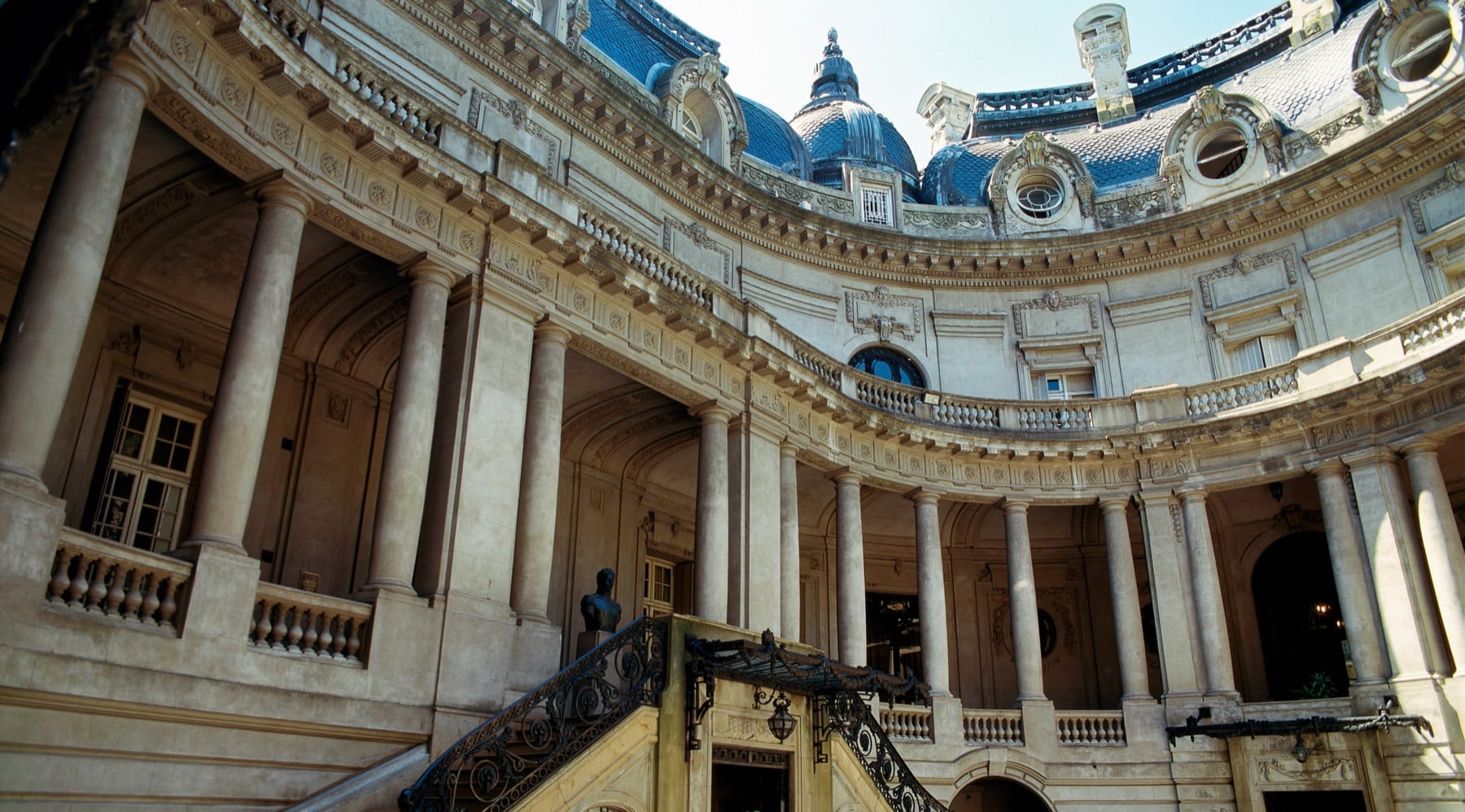
Commissioned by the Chilean diplomat Matías Errázuriz and his Argentine wife Josefina de Alvear, and designed in 1911 by René Sergent, the Paris architect behind several of the grand houses of the 16th arrondissement. Like Sortais, Sergent never saw the site. It was finished in 1917. The couple had spent ten years in Europe, where they assembled the collection the house was built to hold, and the interiors were fitted out by French specialists: oak panelling, Carrara marble, tapestries, parquetry, with the gardens by Achille Duchêne.
The state bought the house in 1936 and opened the Museo Nacional de Arte Decorativo in it a year later, which is the happiest outcome of the four: the rooms are still furnished, so you walk through a house rather than a gallery. If you are building a morning around it, it also appears in our guide to the art museums of Buenos Aires and when they open.
Visiting: open Wednesday to Sunday, 13:00 to 19:00, closed Monday and Tuesday, and admission is free, with no booking needed. Of the four palaces this is the one to prioritise if you only have time for one interior.
→ AV. DEL LIBERTADOR 1902, RECOLETA
04 · PALACIO DUHAU
RECOLETA · PARK HYATT · 1934
The last one built, and the easiest to enter
The last of the line. Completed in 1934 for the Duhau family by the French-born architect León Dourge, who was born in Paris and built his whole career in Argentina, and modelled closely on the Château du Marais outside Paris. It went up when the era that produced the other three was already over. It sits on Avenida Alvear, the street that concentrated more of this architecture than any other in the city, and which runs up to the Ortiz Basualdo palace in the photograph at the top of this page.
It is now part of the Park Hyatt, connected to a modern wing by terraced gardens that step down the slope towards Calle Posadas.
Visiting: you do not need to be a guest, but you do need a reservation. The Piano Nobile salons inside the palace serve food through the day, and the afternoon tea, served 16:00 to 18:30, is the thing they are known for. It is the only one of the four where the way in is simply to book a table.
→ AV. ALVEAR 1661, RECOLETA
The four, at a glance
| Palace | Built | What it is now | Can you get inside? |
|---|---|---|---|
| Palacio Paz | 1902 to 1914 | Círculo Militar and arms museum | Yes, guided tours, confirm the current schedule |
| Palacio San Martín | 1905 to 1909 | Ceremonial seat of the Foreign Ministry | No, tours suspended, facade only |
| Palacio Errázuriz | 1911 to 1917 | Museo Nacional de Arte Decorativo | Yes, Wednesday to Sunday, 13 to 19, free |
| Palacio Duhau | 1934 | Park Hyatt Buenos Aires | Yes, book a table at the Piano Nobile |
How to see them in an afternoon
The four sit within about two and a half kilometres of each other, but the walk between Plaza San Martín and the upper end of Avenida Alvear is uphill, on narrow pavements, past the busiest traffic in the city. Done by car it is a twenty minute loop with three stops, which leaves the afternoon for the two interiors that are actually open rather than for the walking.
A practical order: Palacio Paz in the morning if you have a confirmed tour, Palacio San Martín on the way past for the facade, the Museo de Arte Decorativo after one o'clock when it opens, and tea at the Duhau when the light goes. Two of the four are in Recoleta and the other two in neighbouring Retiro, so the route folds easily into the wider Recoleta walking guide. If you would rather spend the afternoon sitting down than looking up, the cafés notables are the other version of the same century.
Questions we get asked
Can you go inside the Palacio San Martín?
Not at the moment. The Foreign Ministry suspended its guided tours and has not announced a reopening date, so the building can only be seen from Plaza San Martín. Any tour that promises you the interior is working from an outdated page.
Which Buenos Aires palace is free to visit?
The Palacio Errázuriz Alvear, which houses the Museo Nacional de Arte Decorativo at Av. del Libertador 1902. Entry is free and needs no booking, Wednesday to Sunday from 13:00 to 19:00. It is also the one where the rooms are still furnished.
Do you need to stay at the Park Hyatt to see the Palacio Duhau?
No. The Piano Nobile salons inside the palace are open to non-guests with a reservation, and serve lunch, afternoon tea and dinner. Booking a table is the simplest way into any of these buildings.
How long does it take to see all four?
About half a day by car. The four are within roughly two and a half kilometres of each other, but the ground rises between Plaza San Martín and Avenida Alvear and the pavements are narrow, so the walking eats the time you wanted for the interiors.
Plan the afternoon
Plan your private heritage tour. Message us on WhatsApp at +54 9 11 2404-0448 or book a private car for an afternoon through Retiro and Recoleta with a driver who knows the city.