ARCHITECTURE · AVENIDA DE MAYO · 2026
In 1898 a newspaper built itself a palace a few steps from Plaza de Mayo, with a torch on the roof and a siren for the big news, and after a long restoration you can walk through it again.
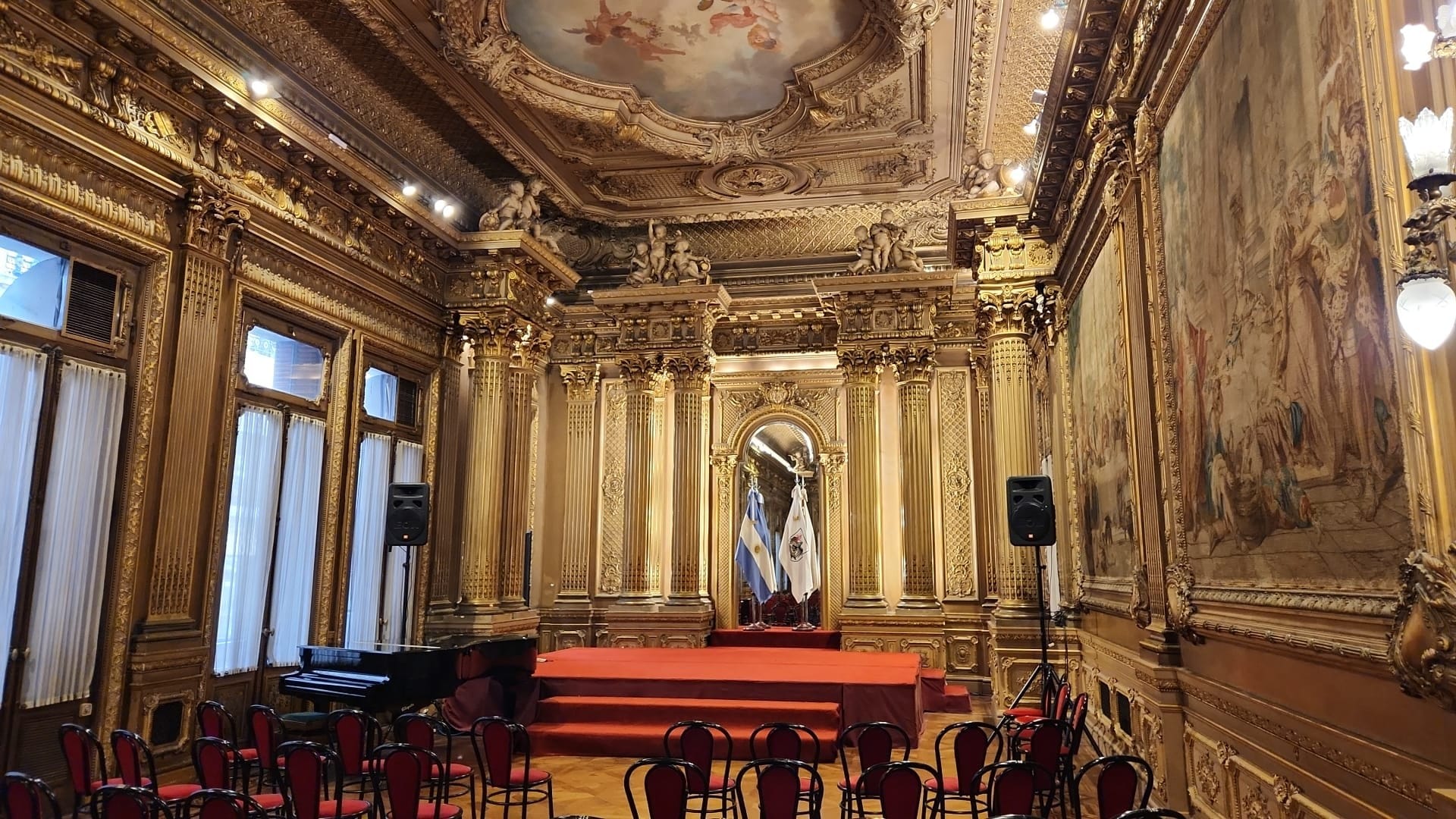
The Salón Dorado, the first-floor hall where La Prensa held its lectures and where the City now programmes free concerts. Photo: Buenos Aires Transfers, September 2026.
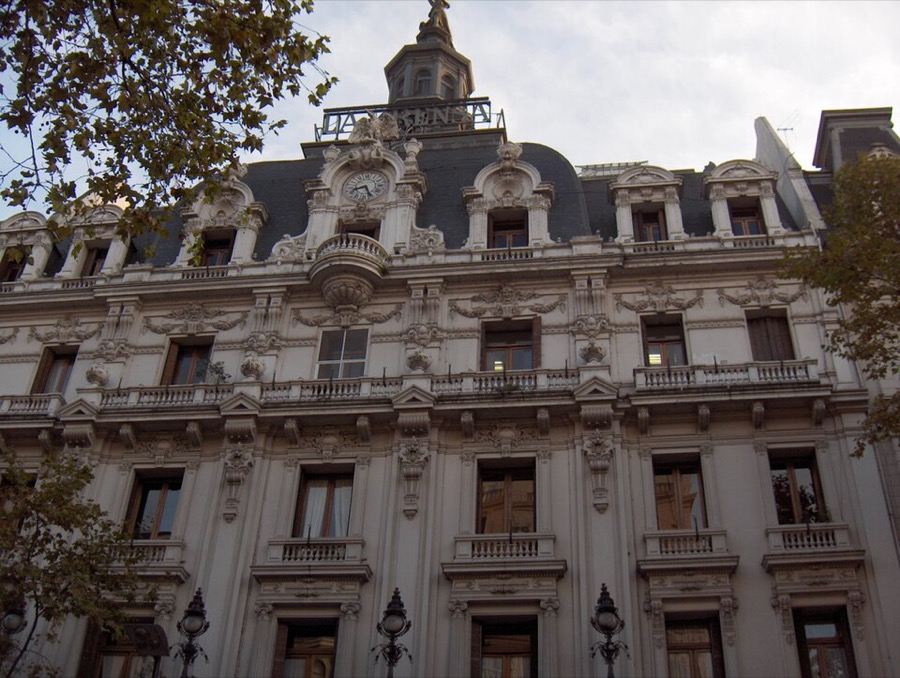
Walk out of Plaza de Mayo along Avenida de Mayo and look up before you reach the first corner. At the top of the façade, above a clock, a bronze woman holds up a torch. The building under her was the home of La Prensa, one of the most influential newspapers in Argentina, and it opened in 1898.
Today it is the Casa de la Cultura, the seat of the City's Ministry of Culture, and since it reopened in September 2025, after a restoration, it receives visitors again, with a café, a library, free concerts and a guided tour in English and Spanish. We went in late September 2026 with a camera, and every photo in this guide is ours. At Buenos Aires Transfers we spend our days moving visitors between the airport, the hotels and the old centre, and this is the address we now give people who have already seen the Casa Rosada and want to see what the city looked like when a newspaper could afford a palace.
01 · THE NEWSPAPER THAT BUILT A PALACE
1869 · 1898 · MADE IN FRANCE
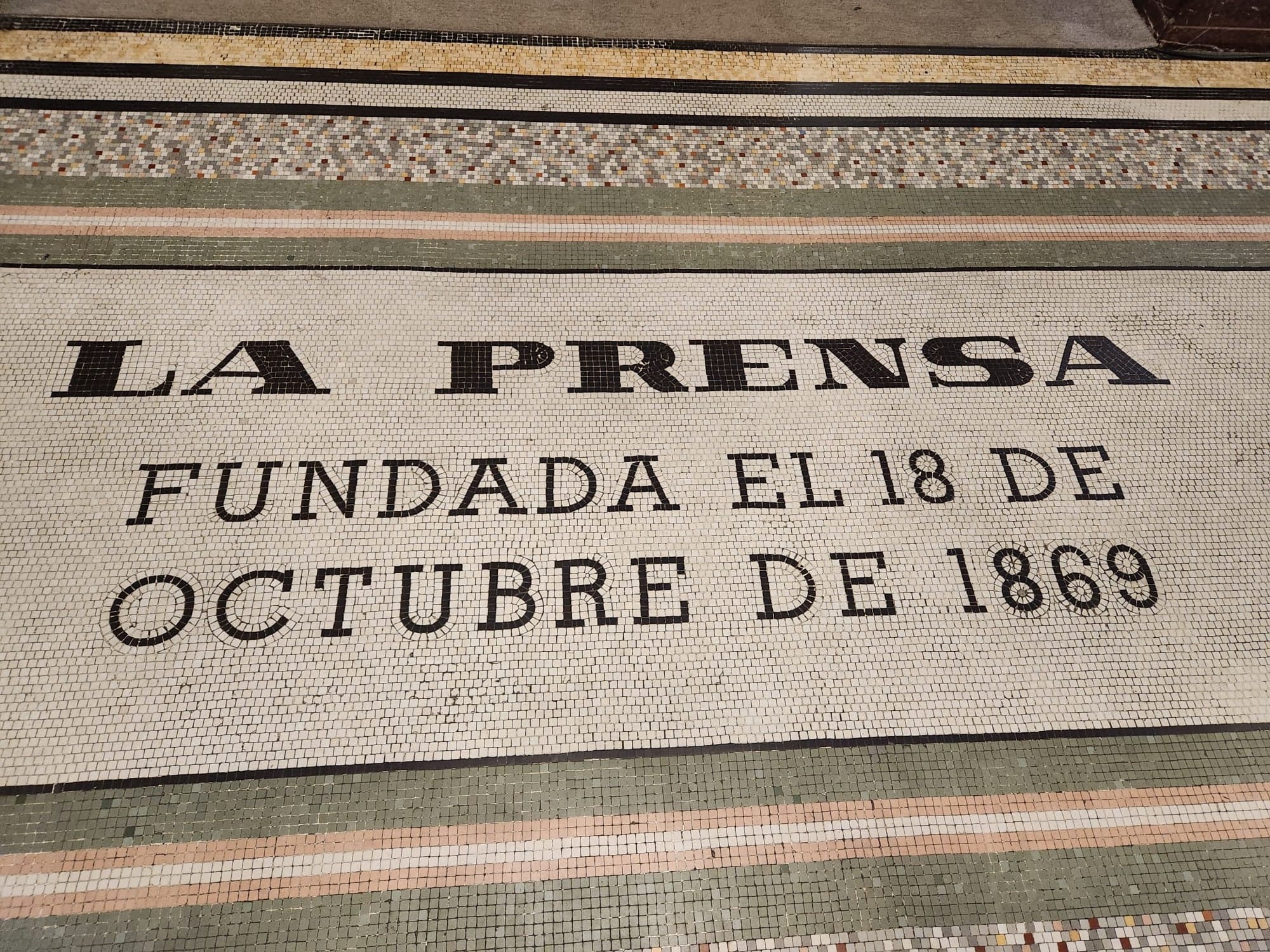
Set into the floor: "La Prensa, founded on 18 October 1869".
La Prensa was founded in 1869 by José C. Paz, and its first issue came out on 18 October that year. The Paz name is also behind one of the grandest private houses in Buenos Aires, the palace on Avenida Santa Fe that appears in our guide to the Belle Époque palaces, and the newspaper got a building just as ambitious.
He commissioned the design of the façade in Paris, and two Argentine engineers, Carlos Agote and Alberto Gainza, completed the project in Buenos Aires. Most of the work went to French firms, which also did all the interior decoration. According to the national monuments commission, the structure was made by Moisant, Laurenti, Savey et Cie., the ironwork and castings by the Val d'Osne foundry, the mosaic floors by J. Boulanger and the façade clock by Paul Garnier. The City adds that the structure arrived in Buenos Aires dismantled, to be put together on site.
What looks like one building is really two, joined around a central courtyard, with staircases that make up for the different floor heights. There are two basements, a ground floor and six upper floors, and the City says it was only the second building in the country to have a lift.
A newspaper of that size was a small town. Besides the presses and the newsroom, the building had flats for employees and their families, free medical and legal consultations, a library of some 6,000 volumes, a weather observatory and a fencing room. Messages travelled between offices in pneumatic tubes, pushed by compressed air, and the original compressors and electrical panels are still in the basements.
→ AV. DE MAYO 575, MONSERRAT
02 · THE FAÇADE: A TORCH, A CLOCK AND A SIREN
LOOK UP FROM THE PAVEMENT
The best view of the building is from the other side of the avenue. At the very top stands the bronze figure with the torch, and the two official sources do not agree on who she is. The City calls her Pallas Athena, the goddess of wisdom, with a torch for wisdom and truth. The national monuments commission describes her as an allegory of journalism: a woman holding a torch in one hand and a written page in the other.
Under her is the Paul Garnier clock, and above the clock an eagle that stood for journalism that sees everything. The electric lanterns along the balcony were a novelty in the 1890s.
The building also had a voice. La Prensa had a siren that sounded when big news broke, and according to the national commission it was first heard in 1900, for the assassination of King Umberto I of Italy. The restoration put it back in working order, and the City says it can be heard several kilometres away.
03 · INSIDE: THE HALL, THE SKYLIGHT AND THE SALÓN DORADO
GROUND FLOOR · FIRST FLOOR
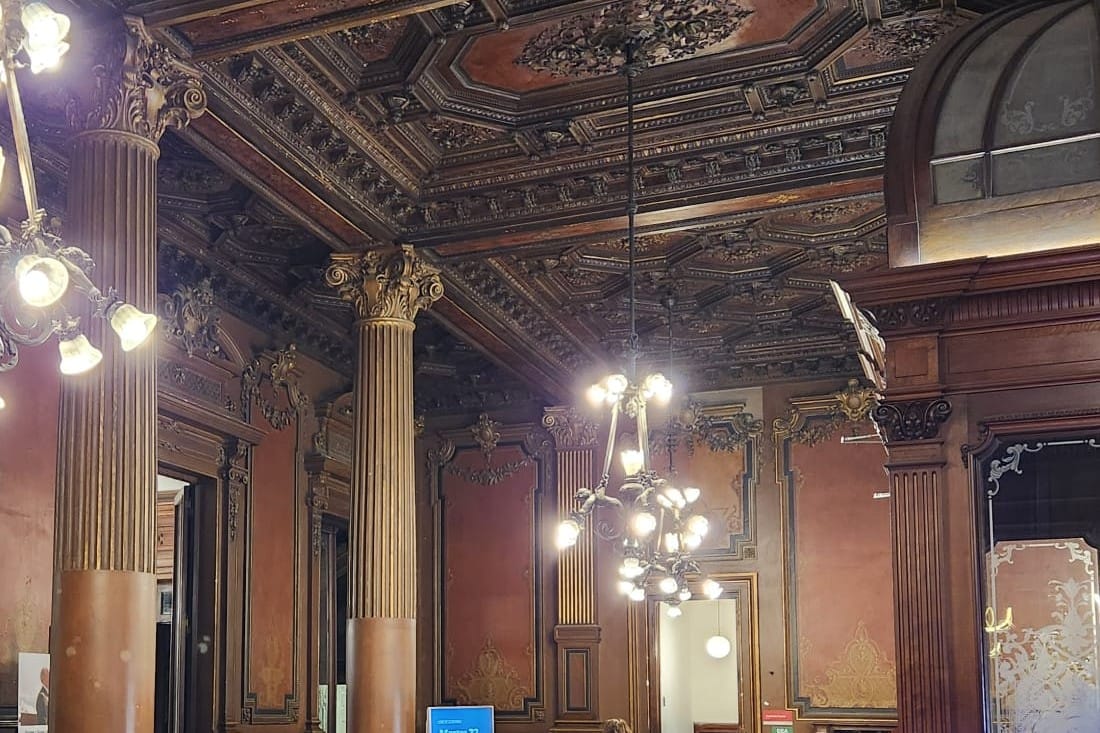
The main hall on the ground floor: columns, carved wood and chandeliers.
You come in through the main hall, where the mosaics and ornaments repeat two symbols, the pen and the torch. Further in, the central courtyard sits under a skylight of iron and hundreds of pieces of glass, which the restoration recovered keeping its original design and replacing only what had deteriorated. The courtyard keeps the building's commemorative plaques and a historic clock, and now has armchairs where you can sit with a coffee and look up.
To the right of the main entrance on Avenida de Mayo there was a gate for carts and carriages. The carriage passage, with its marble sculptures, was how the newspaper's directors arrived by horse-drawn coach, and it has been restored too.
Upstairs is the reason most people come. The Salón Dorado was the newspaper's hall for lectures and parties, with its own stage, decorated in a style the City describes as inspired by Versailles. The Instituto Popular de Conferencias met here every week, with writers, scientists and artists from Argentina and abroad, and there were concerts.
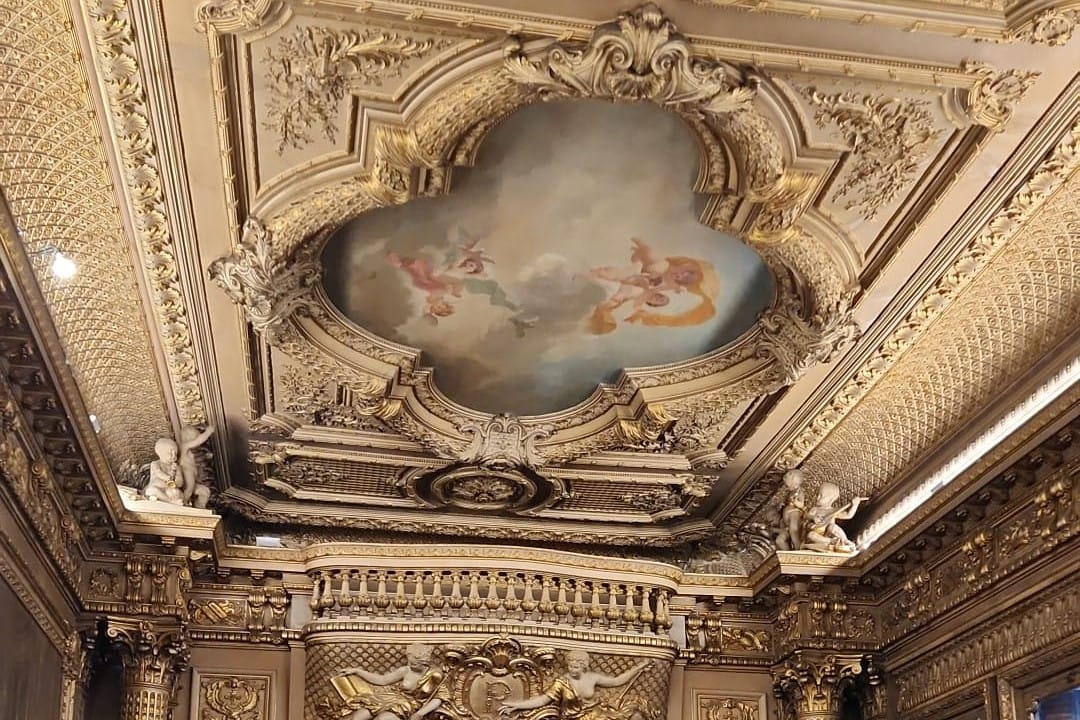
The ceiling of the Salón Dorado, painted by Nazareno Orlandi.
The ceilings of the Salón Dorado were painted by Nazareno Orlandi, an Italian decorative painter who came to Buenos Aires in 1889 to work on the Casa de Gobierno. He also painted the old Grand Splendid theatre, which is today the El Ateneo bookshop on Avenida Santa Fe, so if you liked the dome there (it is in our guide to the city's best bookshops), you will recognise the hand. The grey, single-colour paintings on the ceilings of the first-floor private rooms, once Paz's own, are by Reinaldo Giúdice.
The building also keeps the director's office, with its original furniture, and the newspaper's old library. In the basements, where the presses once ran, there are now rooms for temporary exhibitions.
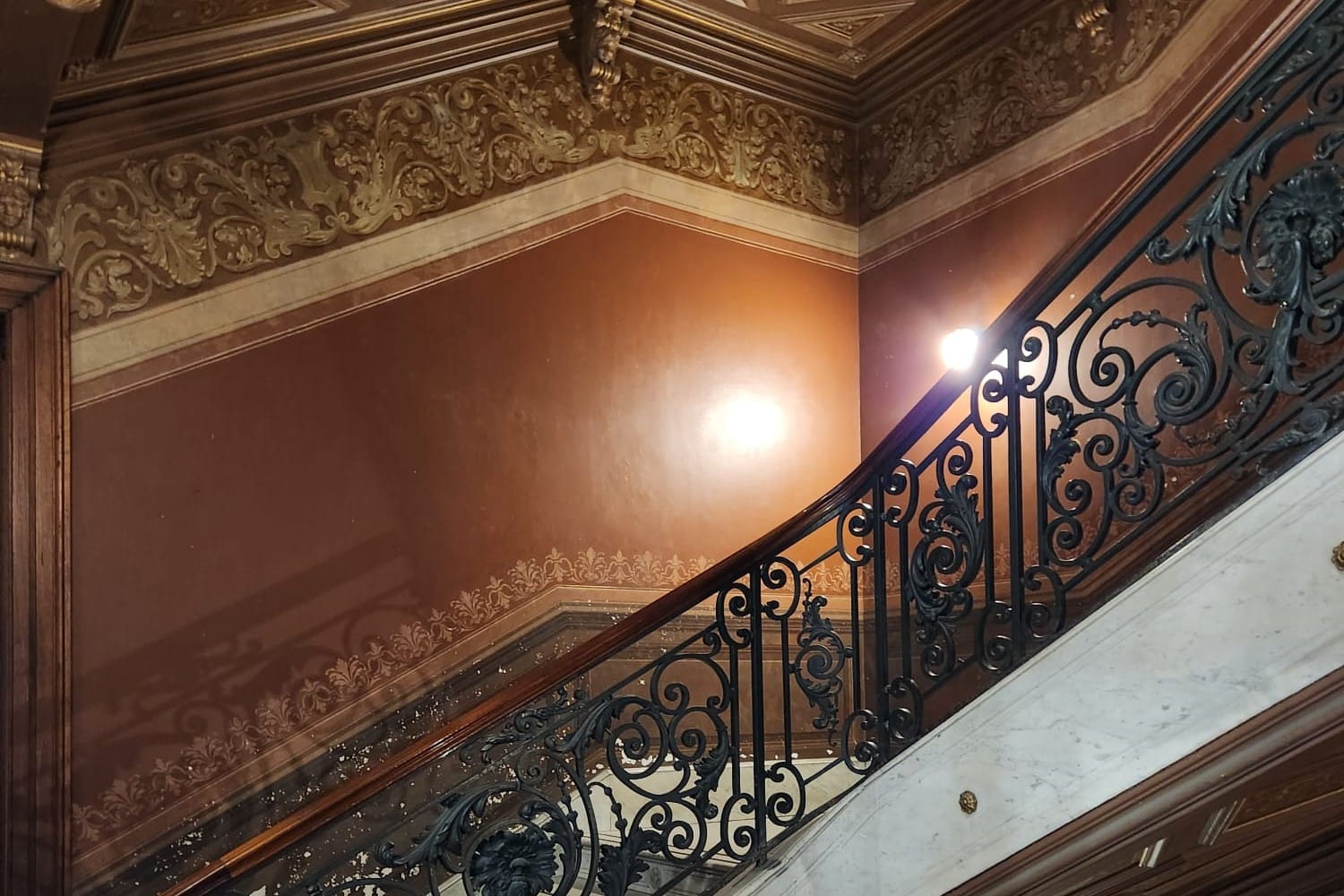
A staircase with its wrought-iron railing and wooden handrail.
Seeing the old centre with a guide? Our private city tours pick you up at your hotel with a guide and a driver for your group only. See the city tours and tell us if you want the morning built around a visit here.
04 · HOW TO VISIT
GUIDED TOUR · CAFÉ · LIBRARY · CONCERTS
The guided tour. It runs Wednesday to Saturday at 11:00, 12:30 and 14:30, lasts 45 minutes and is bilingual, in English and Spanish. There are no tours on Sundays. Tickets are sold through Ticketek from the Casa de la Cultura's official website, with one rate for foreign visitors and lower ones for residents. Prices in Argentina change often, so check the current rate when you book. These are the times published for 2026; older guides that mention free tours at weekends are out of date.
Concerts in the Salón Dorado. The City's music department programmes concerts in the hall, and they are free. Outside the tours, the building opens for its concerts and activities according to its own agenda, so check the programme on the official site before you plan around one.
Café and library. On the ground floor, Bar Periódico serves the classics of a Buenos Aires café, and the Biblioteca Tomás Eloy Martínez, named after the Argentine journalist and novelist, holds literature and journalism. You can take a book to the courtyard or to the café.
Getting there. By Subte, the nearest stations are Perú on line A, Catedral on line D and Bolívar on line E. The building runs through the block, with a second entrance at Rivadavia 576.
05 · A MORNING ON AVENIDA DE MAYO
PLAZA DE MAYO · CAFÉ TORTONI · PALACIO BAROLO
The Casa de la Cultura fits neatly into a morning in the old centre. Start at Plaza de Mayo, take the 11:00 tour, then walk three blocks west along the avenue to the Café Tortoni at number 825 (it is in our guide to the historic cafés). Further along the same avenue stands the Palacio Barolo, another building that is worth looking up at. If you only have one day, our one-day itinerary shows how to fit the centre around everything else.
Questions we get asked
Where is the Casa de la Cultura in Buenos Aires?
At Avenida de Mayo 575, on the first block of the avenue, a few steps from Plaza de Mayo, in the Monserrat neighbourhood. There is a second entrance at Rivadavia 576. The nearest Subte stations are Perú (line A), Catedral (line D) and Bolívar (line E).
When are the guided tours?
Wednesday to Saturday at 11:00, 12:30 and 14:30. Each tour lasts 45 minutes and is given in English and Spanish. There are no tours on Sundays.
Are the guided tours free?
No. Tickets are sold through Ticketek, with a different rate for foreign visitors and for residents. The concerts in the Salón Dorado, on the other hand, are free.
Is this the old La Prensa newspaper building?
Yes. It was built for La Prensa, founded in 1869, and opened in 1898. Today it is the seat of the City's Ministry of Culture and a National Historic Monument.
Can I just go in for a coffee?
There is a café, Bar Periódico, on the ground floor, next to the library and the courtyard. The official site does not publish separate opening hours for the café, so check before you go.
The old centre, at your own pace
Plaza de Mayo, Avenida de Mayo and San Telmo are close to one another, but a morning of tours, cafés and palaces adds up, and the hotel can be far away. Our private city tours come with a guide and a driver, start at your hotel door and are priced per group, not per person: ask us to time the route around the guided visit here. If you would rather set the stops yourself, hire a driver by the hour and keep the car waiting outside.
Welcome to Buenos Aires. Remember to look up.